Rectangles parfaits – 1
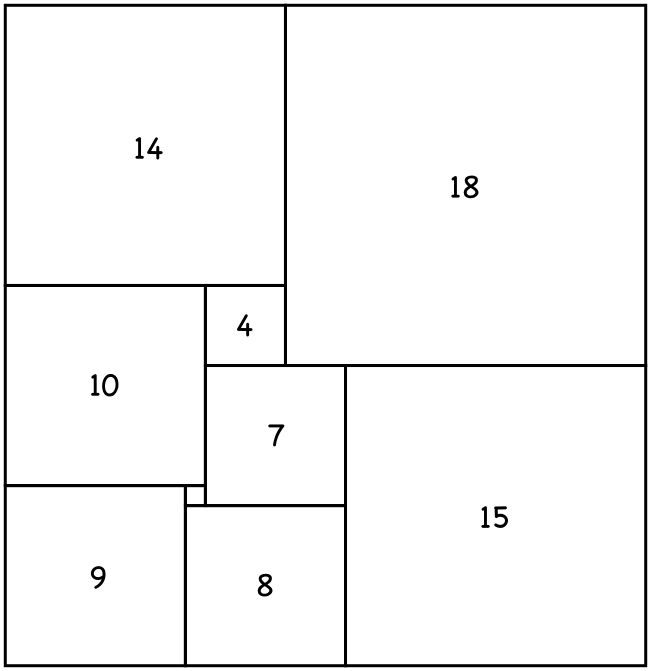
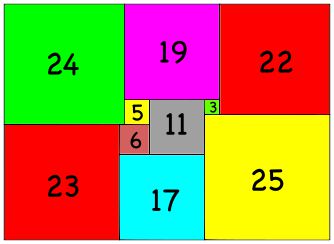
A rectangle that can be filled with squares, no two of which have the same side lengths, is called a Perfect Rectangle. Here is an example of a 47 by 65 Perfect Rectangle filled with 10 squares of different side lengths.
LE DÉFI
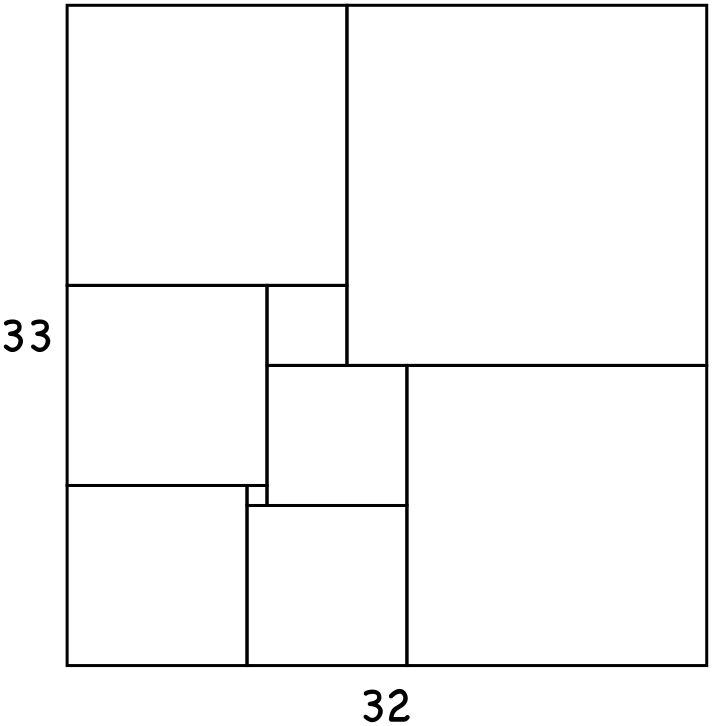
Trouvez les longueurs des côtés des carrés de ce rectangle parfait 33 x 32 rempli de 9 carrés.
Remarques
LE DÉFI
Your students can measure the diagram carefully to come up with the side lengths, but hopefully they will enjoy the challenge of doing the problem solving instead.
Un bon point de départ est constitué des six carrés situés dans le coin inférieur gauche.
Let n be the side length of the smallest square, and x the side length of the square in the Middle of the Bottom row (call it MB for short).
The squares that surround the smallest square increase in side length by n as they go around the smallest square. The square on top of MB has side length x – n, and the square in the bottom left corner has side length x + n. Also the square in the bottom right corner has the combined side lengths of MB and the square on top of MB, so its side lengths is x + (x – n) = 2x – n. The side lengths of the squares on the bottom “row” of this diagram add up to 32, so 32 = (x + n) + x + (2x – n) = 4x, which means x = 8.
The stack along the bottom left side is (x + n) + (x + 2n) = 2x + 3n high. The stack of three squares in the bottom middle is x + (x – n) + middle square = 2x – n + middle square. Because 2x + 3n = 2x – n + middle square, the middle square is 4n in side length. If n is 2, we would have two squares of side length 8. If n is 3 or bigger, that middle square would be too big. So, n = 1.
With x = 8 and n = 1, and knowing the size of the rectangle is 33 by 32, filling in the rest of the squares is automatic.