Shape Sums
Math Concepts
Addition- single digit
Materials
Paper, pencil
Players
1
Set up
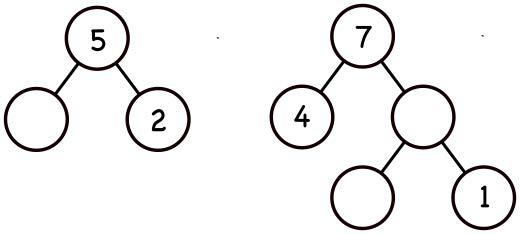
Use a diagram of connected shapes, where each shape is meant to contain a number. The numbers in all the shapes directly below and connected to a shape must add up to the value in that shape. In the examples on the right, 3 should be in the circle in the left diagram, and 2 and 3 should be in the two circles in the right diagram.
How to make
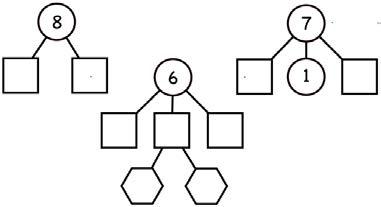
Make these puzzles by starting with a diagram that is completely filled in and then removing some numbers. If the puzzle has some repeated numbers (see notes in Variations), use a square, triangle, or other shape instead of a circle for that repeated number, if you want.
Goal
Fill the empty shapes so that every shape is the sum of all the shapes directly below and connected to it.
Discussion and Tips
Discuss with your students how to use number bonds and fact families to fill in the empty shapes.
Variations
Repeated numbers: One option is to use non-circular shapes for repeated numbers. While the value in a circle may duplicate the value in some other circle or shape, the value in a non-circular shape must match the value in all other places with the same shape. For example, all squares have the same value in a given puzzle. Use matching shapes to practice adding twins, near twins, and halving– in the first example on the left, the solver is asked to find a number that is half of 8.