Families
These resources are for a single family: Use these math games, puzzles, activities, and instructions to enjoy playing with math together.
These resources are for a single family: Use these math games, puzzles, activities, and instructions to enjoy playing with math together.
These math events bring early math to a group of families.
These games, puzzles, and instructional materials are for use in the classroom.
These resources do not fit neatly into the family or educator categories.
These pages give you information about EFM, its mission, and ways we might collaborate.
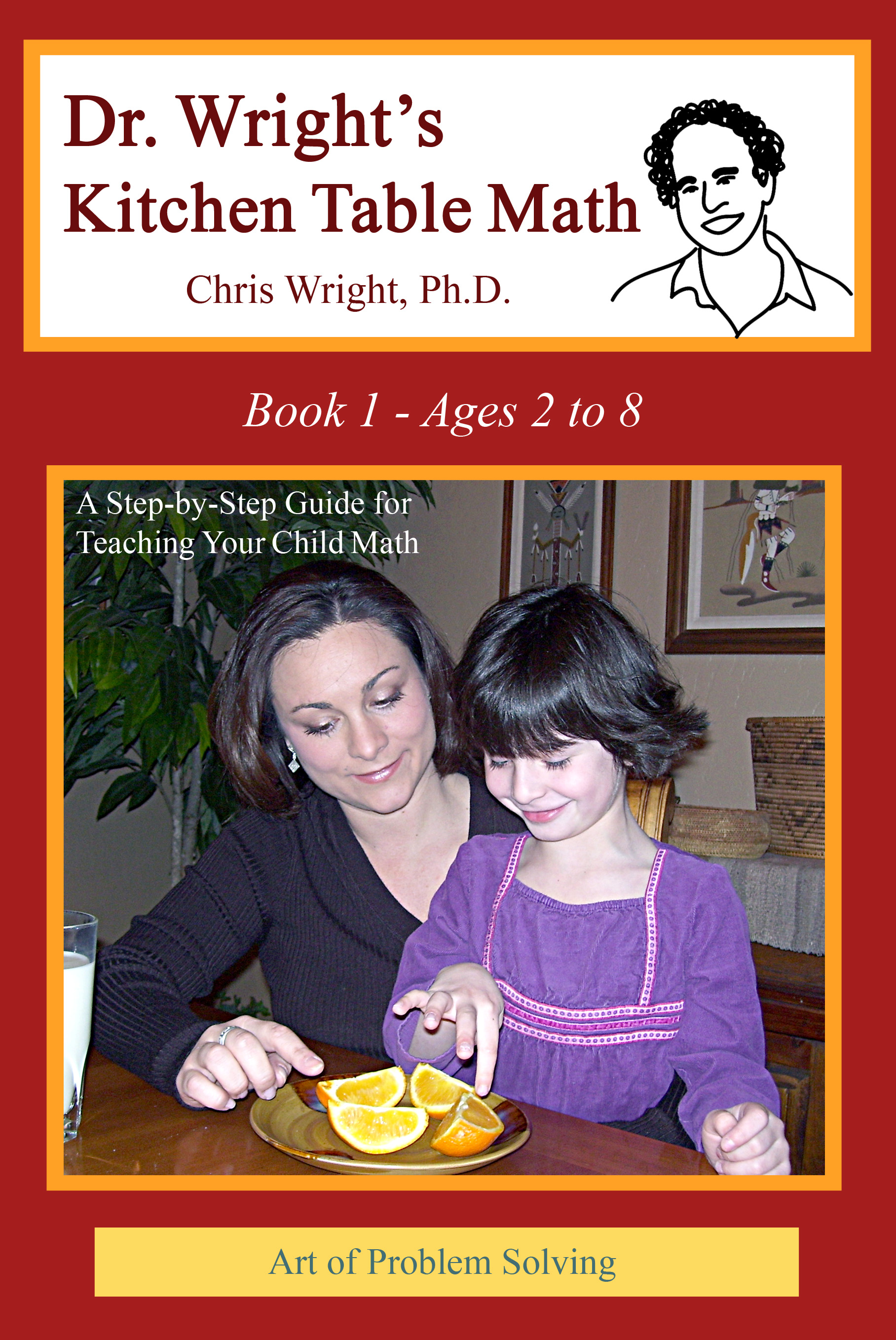
These 3 1/2 books describe all the math that a child learns through about age 12 (book 4 is only half finished). They describe the individual steps in detail in a way that educators or families can use to help their children understand and play with math. However, they do not have as many games and puzzles as the Early Family Math material.
After a couple of weeks of playing games from Kitchen Table Math: Book 1, my four-year-old daughter woke up each morning asking, “Can we play math at the breakfast table?”
It Worked For Me
For as long as I can remember, my dad has made math fun. I had no idea the games we played driving to school or sitting at the kitchen table were teaching me important math skills that put me in the top of my class from elementary through high school. It was my dad’s teaching that helped me place first in the state-wide California Math League in 6th grade, get a perfect score on my AP Calculus BC test in 10th grade, and a perfect score on my math SAT in 11th grade. Now, as a senior at Stanford University, I am grateful that he spent so much time doing math with me, because he helped me get where I am today.
As a lifelong lover of numbers and a teacher of math for 35 years, I find Chris Wright’s Kitchen Table Math (book 1) to be extraordinarily helpful in helping young children learn numerical concepts and enjoy math.
The book is well-organized, starting with beginning counting and continuing through the basic arithmetic operations to some geometry and probability. All ideas are clearly explained and readily accessible to adults and children. One of my favorite parts of the book is the number of fun and engaging activities. When I was young, my family had a “game night” at dinner one evening a week. When it was my or my father’s turn to choose, we always chose math games. How I would have loved to have had some of Chris’ suggestions to use back then or when my own children were growing up. I have bought copies of this book for my several grandchildren, a great niece and great nephew and for the daughter of a young friend of mine.
I highly recommend Kitchen Table Math as a way to help children love working with numbers and recognize that math is a fun and natural part of the world.