Playdate 9: Patterns
Playdate focus
Use properties of things to establish patterns. Patterns are central to mathematics.
Storybook properties:
This talks about the daily feeding of hungry animals.
Activities properties:
These involve properties and finding patterns involving those properties.
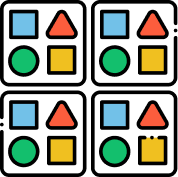

Patterns are everywhere! Recognizing, describing, and creating patterns is central to playing with mathematics.

Here are some characteristics that can be used by themselves or mixed together to create patterns:
- Movement patterns: stepping, jumping, waving, nodding
- Sound patterns: clapping, knee slapping, tongue clicking, stamping
- Loudness patterns: soft, medium, loud
- Visual patterns: color, shape, size
Discover patterns
Challenge each other to find repeating patterns wherever you are. You might notice a repeating tile work in a floor, wall, or ceiling. The brick work of a building might make an interesting pattern. Plants may be planted in an organized pattern in a field. The side of a pineapple or pine cone may have a spiral pattern. Something may be producing sounds in a repeating pattern.
Game: Repeat patterns
Two or more of you can challenge each other to repeat and extend each other’s patterns. This can be done in many ways. The simplest is for one person to create a pattern of sounds and movements and have all the others repeat it.
Add difficulty to this by having the original person add one more item to the end of the pattern every time the pattern goes once around the group. Alternatively, each person can take the pattern that comes to them and one more item at the end of it.
Secret handshakes or knocks
Use patterns as an agreed upon way for being allowed to enter some place such as a room. This might be a series of fist bumps and other type of handshakes. Or it might be knocking and stamping that causes a series of sounds.
Sequence of drawings
For older children, create puzzles by drawing a pattern of shapes. One person establishes a pattern and then leaves gaps in the repeating sequence for the other to fill in.