
Pan Balance With Weights – 6
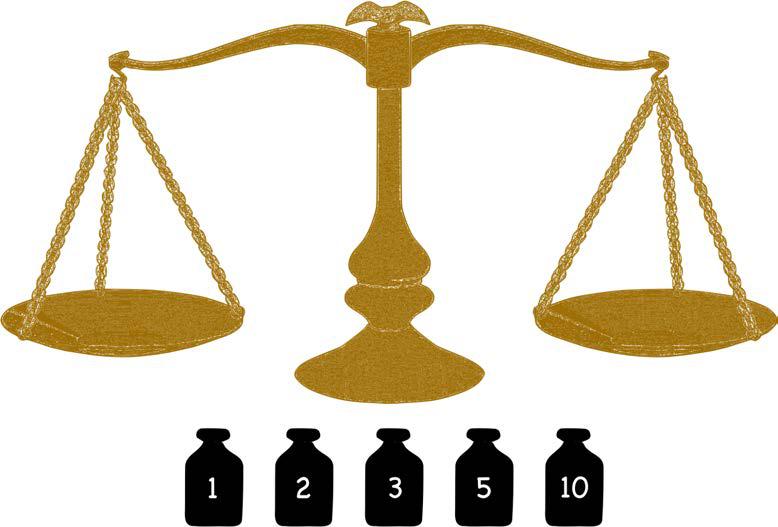
A pan balance tells you when its two sides are carrying the same amount of weight or whether one side is heavier than the other.
THE CHALLENGE
You would like to be able to weigh anything that is a whole number of ounces from 1 ounce up to 40 ounces. If you can put weights on either side or both sides of the pan balance, what is the fewest number of weights that will make this work and what will the weights be?
EXPLORATION
How does your answer change if you want to be able to weigh anything between 1 ounce and 50 ounces? How about other ranges? Are there some ranges where there is only one best answer, and other ranges where there are many?
Notes
THE CHALLENGE
The ideas behind this puzzle take advantage of the base 3 number system, though you do not need to tell your students about that.
The key to this problem is to use the powers of 3. The four numbers 1, 3, 9, and 27, when placed on one side or the other of the scale, can weigh every amount from 1 to 40. For example, if the item weighs 7 ounces, it can be weighed by doing <item> + 3 on one side and 1 + 9 on the other.
EXPLORATION
As with “Pan Balance With Weights – 5,” if the range is not at the maximal amount, then there is flexibility, especially with the largest number in the set. The maximal amount is determined by adding up the powers of three. For example, three weights would have a maximum of 1 + 3 + 9 = 13, and four weights would be 1 + 3 + 9 + 27 = 40, which is the problem we started with.