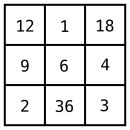
Magic Squares – 7
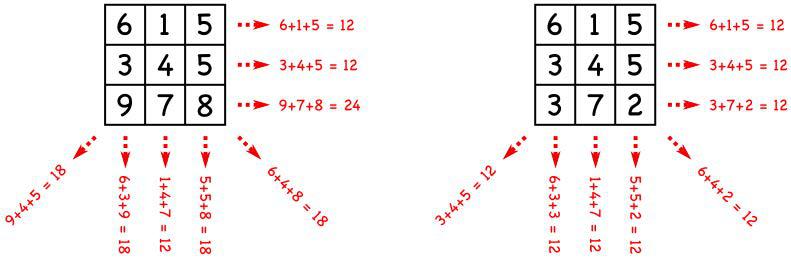
In a traditional Magic Square, all the rows, columns and diagonals add up to the same number. This first square
is not a Magic Square. The second one is a Magic Square with a constant sum of 12.
THE CHALLENGE
Make a Magic Square, without duplicate entries, that uses multiplication instead of
adding. That is, this will be a Magic Square where the entries of each of the rows, columns, and diagonals
multiply to give the same product.
EXPLORATION
If you can make one type of puzzle look like another type of puzzle you already know how to
solve, you can save a lot of work and get some interesting insights. Were you able to use your knowledge of
Adding Magic Squares to help you make Multiplying Magic Squares?
Notes
THE CHALLENGE & EXPLORATION:
With two key ideas, these puzzles become very easy.
The first idea is to use prime factorizations. If you prime factor all the numbers, you will quickly see that what happens for one prime has no effect on what happens for all the other primes. Take this solution as an example.
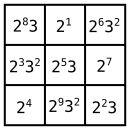
Thinking multiplicatively, this can be split into two squares that get multiplied by each other term by term. Notice that what happens in the powers of 2 Magic Square does not influence and is not dependent at all on what happens in the powers of 3 Magic Square.
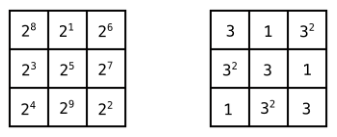
The second idea becomes evident looking at these squares. The exponents in each square form an additive Magic Square!
To summarize, to create a multiplicative Magic Square, make multiplicative Magic Squares for each prime you want to involve, and then multiply together those squares. To make the squares for the individual primes, use additive Magic Squares for the exponents.
Here is a final example that uses smaller numbers. The common product is 216.