
Equal Products
THE CHALLENGE
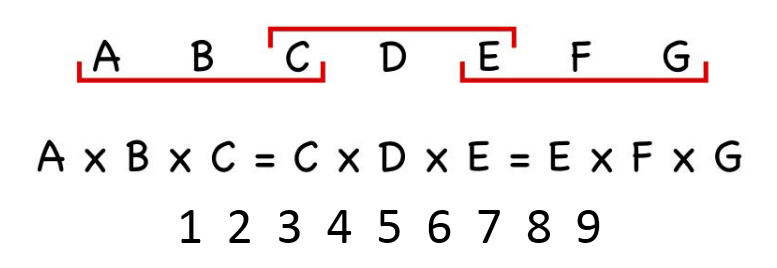
Find seven different single digits that make these three products the same.
EXPLORATION
After you solve this, think about what makes this an interesting puzzle. How might you change the puzzle and still keep it interesting? What happens if you use addition instead of multiplication?
Notes
THE CHALLENGE:
First notice that 5 cannot be one of the digits. If it were, it could be in at most two of the groups of three – this would mean one or two of the groups would have a factor of 5, but the remaining one(s) would not. Similarly, 7 cannot be one of the digits.
That leaves the seven digits, 1, 2, 3, 4, 6, 8, and 9, all of which must be used.
Using prime factorizations makes it a lot easier to understand what happens in the remainder of the analysis. We will need to balance the number of factors of 2 and the number of factors of 3 among the three products.
The product of these seven digits is 27 × 34. What must the common product be? It must be at least 23 × 32 as there will be an 8 and a 9 somewhere in the solution. If we multiply out the three groups, that creates a total product of 29 × 36. Because C and E are the only repeated letters in multiplying together the three products, that means C × E = 22 × 32. The only way to do this is to have C and E be 4 and 9.
A quick check reveals that increasing the power of 2 or 3 will not work out.
Once we set C = 9 and E = 4, the rest follows quickly.
The answer is: 1 8 9 2 4 3 6.
EXPLORATION:
What makes this puzzle interesting is the role prime numbers play in it. Also, the selection of numbers is two more than the number of digits needed, and we are able to rule out exactly two of the possibilities.
If we were to use addition instead of multiplication, there would be way too many solutions. A good puzzle incorporates constraints that narrow it down to having just a few solutions.