
Pirates with Gold – 2
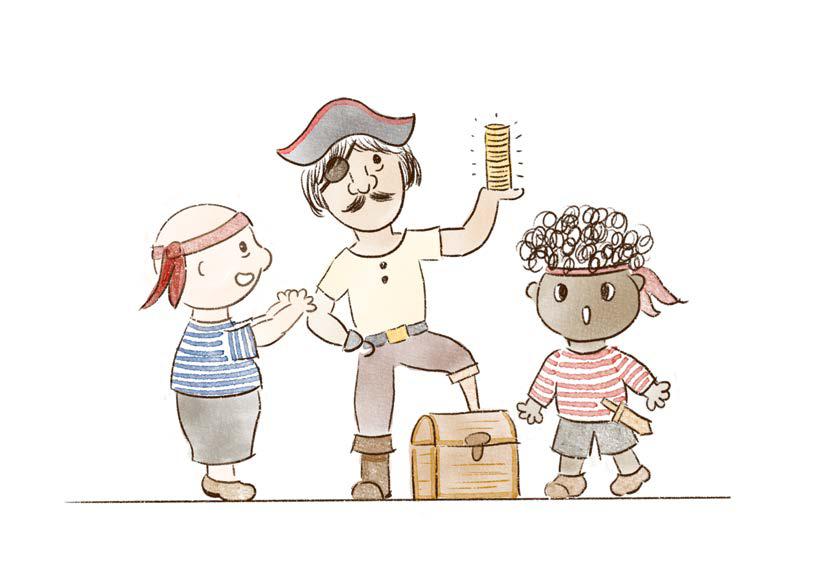
There are five pirates on an island, and they have a total of 12 gold coins.
The rules are:
- The pirates are very smart.
- Each pirate wants as much of the gold as possible for themselves, and does not care about the others.
- The youngest pirate must propose a plan for splitting up the gold. If the plan is acceptable to over half of all the pirates (including the youngest), then the plan is adopted. Otherwise, the youngest pirate is forced to leave the island with no gold, and the new youngest pirate must propose a plan.
THE CHALLENGE
What is the most gold coins the youngest pirate can get in an acceptable plan?
EXPLORATION
Explore what happens when there are more than five pirates.
Notes
THE CHALLENGE
This puzzle provides great practice with two problem-solving techniques. The first is to learn from examples and simpler versions of the problem. The second is to use a table or other organizational scheme to arrange the data in an easy to understand way.
In “Pirates with Gold – 1” we looked at what happens when there are 1, 2, or 3 pirates. Because there are starting to be a lot of cases to look at, we’ll organize the information into a table. The table will show how many gold coins the best plan (for the youngest pirate) will give to each of the pirates. For ease of reference, we’ll name the pirates A, B, C, D, and E, in order of age, with A the youngest and E the oldest.
An X in the table means the pirate was not involved in that version of the problem.
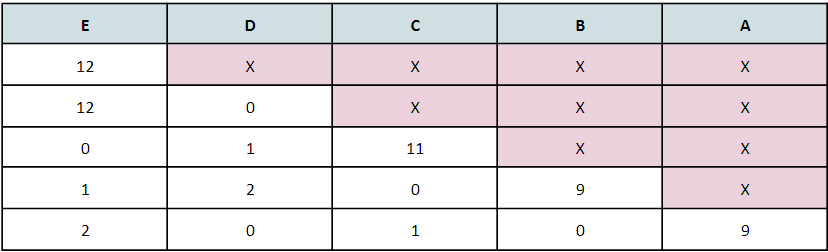
We looked at the plans for the first three rows in “Pirates with Gold – 1.” To review, if E is the only pirate, then E gets all the gold. If D and E are the only pirates, then D must give all the gold to E or E won’t vote for D’s plan. If the pirates are C, D, and E, then C needs one more vote – C can get that vote by giving D more gold than D would get if D votes against C’s plan.
Suppose the pirates are B, C, D, and E. B needs two other votes to get B’s plan approved. That means B must give more gold to two pirates than they would get if they reject B’s plan. The best way to do that is for B to give E one piece of gold and D two pieces of gold.
Finally, suppose all five pirates are involved. A needs two other votes to get A’s plan approved. Once again, that means A must give more gold to two pirates than they would get if they reject A’s plan. This is mostly easily done by giving E two pieces of gold and C one piece of gold.
The answer to the puzzle is: The youngest pirate gets to keep 9 pieces of gold!