Counting Neighbors
Math Concepts:
All operations with 1- 6
Materials:
Paper, 2 colors of markers, playing cards
Players:
2 to 4
Set up
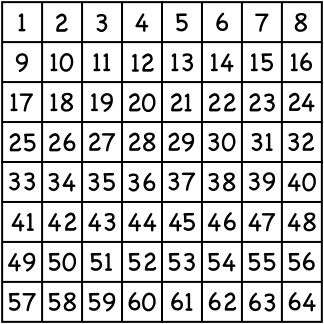
Use three dice, a shared 8 by 8 board of numbers from 1 to 64, and a scoresheet. Either use shared tokens or a pencil to mark the used squares on the board
Play
During a turn, a player rolls the dice and uses addition, subtraction, multiplication, and division to involve all the numbers to equal any unmarked number on the board. The player marks this square and receives one point for the square plus one more point for each marked square that it touches, including diagonally touching squares. If a player cannot make a play, any other player who finds a play can claim that score.
Goal
Play a preset number of rounds. At the end, the player with the largest score wins.
Discussion and Tips
Discuss the advantages and disadvantages of marking squares that have a few or a lot of empty neighbors.
Variations
Use fewer or more dice to make it easier or harder. Another option is to use numbered playing cards to change the range of numbers.
Match your students’ skill level by using smaller or larger ranges on the boards.
Use only addition and subtraction with four dice with a board from 1 to 24.