Divide Up the Box
Set up
A piece of paper with a 4 by 4 (or larger) puzzle on it. Pieces of graph paper are handy for this puzzle. Some of the squares will have numbers on them.
Challenge
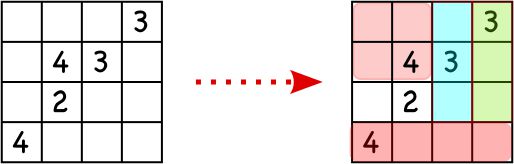
Divide the array of squares into smaller rectangles. Each number must end up in a separate rectangle whose area is that number.
Creation
Out of the sight of the students, create these puzzles by first filling in the big rectangle with smaller rectangles. Next, place the number for the area somewhere in each rectangle. Lastly, use the big rectangle with only the numbers in it.
Discussion and Tips
Discuss which parts of the puzzles are easiest to attack first. Good places to start are areas that are prime numbers. If the area is 3, the rectangle must be 1 by 3 or 3 by 1.
Next, look for regions that are boxed in. In this puzzle, the upper “4” must relate to the upper left 2 by 2 square. After that, the rectangles for the upper right corner’s 3 and the lower left corner’s 4 are determined.
These are also good ideas to keep in mind when you create your own puzzles- your students will have an easier or harder time depending on your use of prime numbers and boxed in regions.
Variations
Use larger game boards for more experienced students.