Same and Different
Math Concepts
Properties of objects
Materials
Random objects, magazine clippings
Players
Pairs or Whole group discussion
Set up
Put your students into pairs.
Play
One student of each pair picks two objects, two descriptions, or two pictures, and challenges the other student to find ways that the objects are the same and how they are different. If they don’t agree on the analysis, or if the questioner feels some ideas have been missed, they can discuss their ideas.
Example
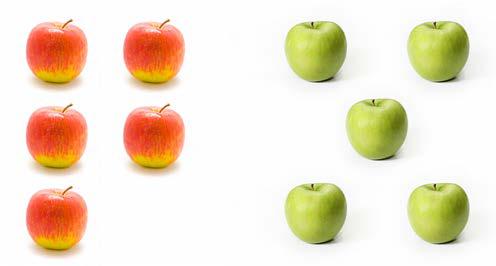
Consider these two pictures of collections of apples. They are the same: 1) both have five things 2) both involve apples 3) the objects are approximately the same size. They are different: 1) the configuration of the five things is different 2) the apples on the left are red and yellow, those on the right are green 3) the stems on the left are longer. Of course, creative minds will come up with many other interesting observations about these two photos.
Goal
Have fun identifying and describing properties of objects.
Discussion and Tips
Identifying properties of objects, and discussing similarities and differences, is central to mathematics.
Encourage your students to come up with all sorts of crazy ideas that no one else will come up with.
There are a lot of pairs of images on Dr. Sue Looney’s website for her book Same but Different. Check it out at https://www.samebutdifferentmath.com/
Variations
Choose any single item and ask which things in the room are similar to it and which things are very different.
Make this into a competitive team game by splitting your class into small groups of two to six students. Show two things to all the groups and give them two minutes to write down their ideas for Same and Different. A group scores a point for each (reasonable) idea that no other group thinks of.
This activity is related to the Which One Doesn’t Belong activity, which you will find elsewhere in this packet.