
Counting the Ancestors of Bees
A female bee’s egg can have one of two things happen. If a male bee is not involved, then the egg will turn into a male bee. If a male bee is involved, the egg will turn into a female bee.
The ancestry of a typical male bee starts with a mother and no father – it has 1 ancestor 1 generation back. Its mother has a mother and father, so it has two grandparents – it has 2 ancestors 2 generations back. And so on. Here is the start of its ancestral tree.
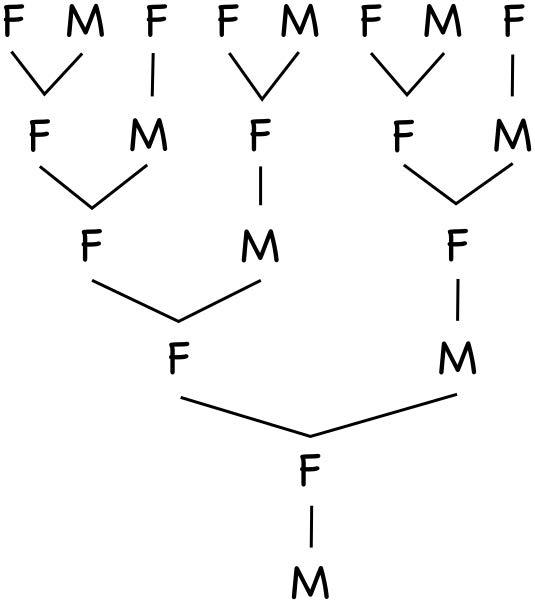
THE CHALLENGE
How many ancestors will a male bee have 10 generations back? How about 20 generations back?
EXPLORATION
Find a pattern that will help you make these calculations more easily. What does the ancestry of a female bee look like? What simplifications are we making in doing all this counting?
Notes
THE CHALLENGE & EXPLORATION
These numbers are the Fibonacci Numbers. After doing a few generations of the bee’s ancestors, the numbers are: 1 (the male bee), 1 (the mother), 2 (the mother and father), 3, 5, 8, 13, 21, 34, 55, and 89.
The key to making this easy to calculate is the following. For a given generation, everyone of the bees will have a mother. The number of fathers is the number of mothers in that generation, and that is exactly the number of bees in the generation before the given generation. In other words, the number of bees in the next generation is equal to the number of bees in this generation plus the number of bees in the previous generation.
This is exactly the rule for finding Fibonacci Numbers. The next Fibonacci Number is always the sum of the previous two numbers.
Our sequence is 1, 1, 2, 3, 5, 8, 13, 21, 34, 55, 89, 144, 233, 377, 610, 987, 1597, 2584, 4181, 6765, and 10946. I have underlined every fifth number, so the tenth number is 89 and the 20th number is 10946.
The numbers for the generations of a female bee will be exactly the same, only moved forward one generation.
The simplification we are making is that we assume that no bee is involved more than once as the ancestor of a given bee.