
Dominoes on Checkerboards
The first of these two checkerboards is easy to cover with dominoes. The second one, which has one square missing, is impossible to cover with dominoes.
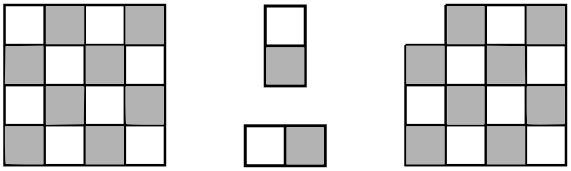
THE CHALLENGE
Describe why one of these checkerboards is easy to cover with dominoes and the other one is impossible.
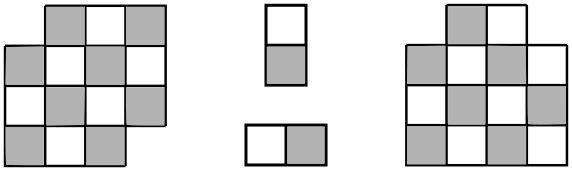
EXPLORATION
Explore which pairs of small squares you can remove from the original board and still be able to exactly cover the remaining board with dominoes.
Notes
THE CHALLENGE
There are two formulas to look at for this puzzle.
The first is whether the total number of squares available is even or odd. Because a domino has an even number of squares, every time a domino is put on a board, the number of available squares is reduced by an even number. Therefore, if there were an even number of squares available before the domino, it will still be even after the domino, and if there were an odd number of squares before the domino, it will still be odd.
For the introductory examples at the top of the first page, the first example has an even number of squares, so it is numerically possible to end with 0 squares (which is an even number). The second example starts with an odd number of squares, so it is impossible for it to be covered with dominoes.
The second formula is to take the difference between the number of dark squares and the number of light ones. When a domino is put on the board, it covers a dark square and a light square, so the difference of those counts stays the same. For example, the difference is 8 – 6 = 2 before any dominoes are placed (looking at the first challenge board), and it will be 7 – 5 = 2 after placing a domino. A formula such as this, that does not change during moves in a game or puzzle, is called an invariant.
Because the difference starts at 8 – 6 = 2 for the first challenge board, it can never be completely covered by dominoes (which would bring the difference to 0 – 0 = 0).
The second board starts with a difference 7 – 7 = 0, so there is a chance that it can be covered. It is actually quite easy to cover the second board with dominoes.
EXPLORATION: Calculating the difference of dark and white squares tells you a lot about which boards can be done. The only difference that gives a chance for success is a difference of 0. If you were to remove four squares, it is possible to have a difference of 0 and not be able to cover the remaining squares – this happens when one of the corner squares gets isolated. However, generally speaking, if the difference is 0 you will almost always be able to cover the board with dominoes.