15 Sliding Puzzle
The setup
Start with a 4 x 4 empty grid of squares formed by 5 horizontal and vertical lines. Use a set of 15 pieces of paper the size of the grid squares, and number the pieces of paper from 1 to 15. The puzzle starts by having someone place the pieces of paper on the grid.
The challenge
The object of the puzzle is to get the pieces of paper in order with only the lower right hand corner of the grid empty. To achieve this, a piece of paper can be moved if it is adjacent to the empty square – in which case it can be slid into that space. Depending on how the person sets up the puzzle, the puzzle may or may not be solvable.
How to create
To create these puzzles, you have two options. The first is to place the squares randomly, in which case you have a 50 / 50 chance of the position being solvable. Alternatively, you can start by placing the pieces of paper in the final position and then making a series of legal moves to move the paper around. When you are all done, you are guaranteed that the puzzle is solvable.
Different sizes
If a 4 x 4 grid is too hard for a beginner, start with something smaller. The grid could be as small as 2 x 2 or as big as the child wants. The number of numbered pieces of paper will always be one less than the size of the grid. For example, on a 2 x 3 grid use the cards from 1 to 5.
Bonus Material
Puzzle Description
The classic version of this puzzle starts with a 4 x 4 empty grid of squares formed by 5 horizontal and vertical lines. Use a set of 15 pieces of paper the size of the grid squares, and number the pieces of paper from 1 to 15. The puzzle starts by having someone place the pieces of paper on the grid. The object of the puzzle is to get the pieces of paper in order with only the lower right hand corner of the grid empty. To achieve this, a piece of paper can be moved if it is adjacent to the empty square – in which case it can be slid into that space. Depending on how the person sets up the puzzle, the puzzle may or may not be solvable.
A 4 x 4 grid is too hard for a beginner, so start with something smaller. The grid could be as small as 2 x 2 or as big as the child wants. The number of numbered pieces of paper will always be one less than the size of the grid. For example, on a 2 x 3 grid use the cards from 1 to 5.
To create these puzzles, you have two options. The first is to place the squares randomly, in which case you have a 50 / 50 chance of the position being solvable. Alternatively, you can start by placing the pieces of paper in the final position and then making a series of legal moves to move the paper around. When you are all done, you are guaranteed that the puzzle is solvable.
Solving the Puzzle
The main reason for a child to play with this puzzle is to have fun moving pieces around until they accidentally solve it and also to practice getting numbers in order. Despite that simple goal, you may start to wonder about deeper ideas in the puzzle.
A frequent theme of problem solving is to learn from simpler problems or examples. So, let’s do that.
The smallest example is 2 by 2. For this size, it is clear that the rows will end up being either 1 2; 3 0 or 1 3; 2 0.
The next smallest is 2 by 3. Start this by getting the 1 and 4 in the left column. Once this is done, your puzzle will look like 1 _ _; 4 _ _ . Finish off the last four squares as you would the 2 by 2 case.
The 2 by 4 puzzle is done similarly. Start by putting 1 and 5 in the left column. Next, put the 2 and 6 in the second left column without disturbing the 1 and 4. Finally finish off the last 2 by 2.
At this point, the pattern for attacking puzzles with 2 rows is clear. What to do with more than 2 rows? Suppose you have 3 rows. Start the solution by getting the top row correctly laid out. After that, leave the top row undisturbed and use your ability to solve a puzzle with 2 rows.
Similarly, if there are 4 rows, do the top row first, the second row next (without disturbing the top row), and finish off the last 2 rows as before.
Is This Puzzle Solvable?
Okay, you have a simple method for solving the puzzle. The next question is: How can I just look at the puzzle and know whether it is solvable or not?
To make describing the answer as simple as possible, do a few quick moves, if needed, to place the empty square in the bottom row. Next, make a list of the rows in one long list – the first row is listed first, the second row is listed second, and so on with the last row listed last. Omit the empty square when you list the last row.
Take this long list and count the number of inversions in it. When a number earlier in the list is larger than a number later in the list, this is called an inversion. If the number of inversions is an even number, then the puzzle is solvable. If it is an odd number, it is not.
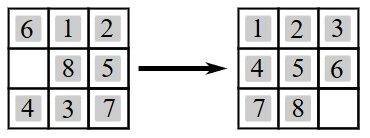
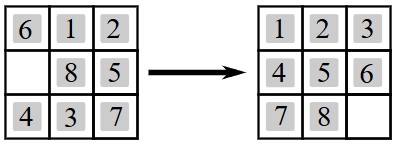
As an example, take the 3 by 3 puzzle at the start of this discussion. Start by moving the 4 up to the second row. Then the list is: 6 1 2 4 8 5 3 7. There are 10 inversions in this list: 6 1, 6 2, 6 4, 6 5, 6 3, 4 3, 8 5, 8 3, 8 7, and 5 3. There are an even number of inversions, so the puzzle is solvable.
Why does this rule work? I won’t drag you through a detailed analysis. The key idea is to keep track of the number of inversions every time you make a move. It turns out that, if you adjust for the hole being in the last row, the number of inversions must always change by an even number after any move. Consequently, if the number of inversions starts as an odd number, it can never get down to 0 inversions.
Helping your child
Puzzles are meant to be challenging and to take time, so please don’t ruin the fun by telling your child how to do them. These puzzles are chosen so that you can create them easily and then have fun solving them together.
If your child gets stuck on a puzzle, you have several options. You can, of course, give very small hints, if you can think of things that won’t give away the puzzle. You can suggest looking at smaller or simpler versions of the puzzle. Encourage your child to be bold in their ideas, even if sometimes they lead to dead ends. We all learn a lot from our mistakes and dead ends! Let your child know that it is perfectly okay not to solve a puzzle on the first (or second or third) try, and that useful ideas may occur to them if they leave the puzzle alone for a day or two.
These puzzles are meant to be fun and to teach problem solving. One of the greatest mathematical pleasures is that AHA moment, after many false starts and much wrestling with a problem, when the answer is finally discovered – be sure to let your child experience that feeling of discovery as many times as you can!