Bonded Groups
There are two versions of these puzzles.
Version 1
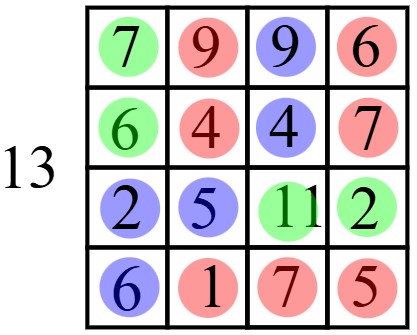
The is the same as the Sum Groups puzzles in Stage 3, only now the target sums can be bigger. The boards can be any size, and here we use a 4 by 4 board. The target number is on the left, which is 13 in this case.
Version 2
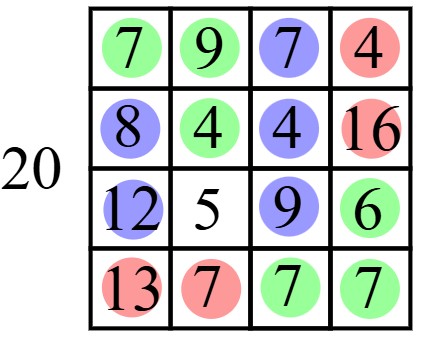
Here is an example of a 4 by 4 board with a target number of 20. As in Sum Groups, the board is filled with pairs and triples of numbers that add up to the target. However, now there will be one square not involved in any of those groups.
The challenge
The challenge is to find the single square that has that number. In this example, it is ‘5.’
Helping your child
Puzzles are meant to be challenging and to take time, so please don’t ruin the fun by telling your child how to do them. These puzzles are chosen so that you can create them easily and then have fun solving them together.
If your child gets stuck on a puzzle, you have several options. You can, of course, give very small hints, if you can think of things that won’t give away the puzzle. You can suggest looking at smaller or simpler versions of the puzzle. Encourage your child to be bold in their ideas, even if sometimes they lead to dead ends. We all learn a lot from our mistakes and dead ends! Let your child know that it is perfectly okay not to solve a puzzle on the first (or second or third) try, and that useful ideas may occur to them if they leave the puzzle alone for a day or two.
These puzzles are meant to be fun and to teach problem solving. One of the greatest mathematical pleasures is that AHA moment, after many false starts and much wrestling with a problem, when the answer is finally discovered – be sure to let your child experience that feeling of discovery as many times as you can!