Bouncing Billiard Ball
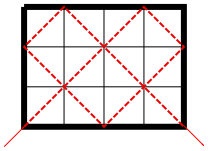
Imagine a billiard table that has a pocket in each of the four corners. When a ball bounces off the side of the table, it bounces away at the same angle it came in at.
This investigation looks at the question: If we shoot a ball at a 45 degree angle from one corner, where will it end up?
The answer depends on the size of the table. This is what happens on a 3 by 4 table.
Investigation
After playing with several different sizes of tables, challenge your child to predict what the answer is in advance for new sizes. Starting in the bottom left corner, which corner will be hit first and how many bounces will it take?
Bonus Material
Introduction
Imagine a billiard table that has a pocket in each corner. When a ball bounces off the side of the table, it bounces away at the same angle it came in at. If we shoot a ball at a 45 degree angle from the lower left corner, where will it end up? The answer depends on the size of the table. Pictured at right is what happens on a 3 by 4 table.
Give your child a drawing of a table and challenge your child to predict which corner will be hit first and how many bounces it will take before getting to that corner.
Analysis
Start by letting your child just play around with this and don’t be in a hurry discovering results. As you will see, this problem involves some sophisticated ideas for a young person. As needed, ask a question or two to give their thinking a little more structure. You know what’s coming – look at simpler tables first to look for patterns – when this idea becomes automatic for your child, this will serve them well for the rest of their lives!
The simplest tables are 1 by n, and they are easy to understand. Playing with a few values of n, the pattern emerges quickly. It is easy to undervalue a simple result like this; however, any completely understood result is to be celebrated, and this result will lead to others.
Result 1 by n table: The ball will take n-1 bounces. The ball will end up in the bottom right corner if n is even and in the upper right corner if n is odd.
The next simplest tables are 2 by n. The patterns here are a little more involved. Good record keeping can make a big difference in something like this. An observant experimenter will notice that a 2 by 4 table behaves just like a 1 by 2 table, and a 2 by 6 table just like a 1 by 3. This quickly generalizes to the next result.
Result A 2 by 2xn table behaves just like a 1 by n table.
Why is this? What is going on? This is a mathematical process to instill in your child – look for patterns and then seek to understand them, and with that new understanding extend your earlier results.
What is going on is that the bounces on a table do not change if you enlarge both dimensions by the same factor. When that is done, the table is bigger but the geometry is the same. In geometry terms, the two tables are said to be “similar.”
Result A kxm by kxn table behaves exactly like an m by n table.
We have gotten here in little steps, but this is a BIG result. It means we can start our analysis on any table by first removing any common factor.
Resuming where we left off for 2 by n tables. We understand what happens when n is even, but what happens when n is odd? What happens for 2 by n for n = 1, 3, 5, 7, and so on? The pattern quickly becomes easy to see.
Result When n is odd, a 2 by n table has n bounces and ends up in the upper left hand corner.
Lots of progress is being made. Playing with more examples leads to some more patterns.
Result If n is not a multiple of 3, a 3 by n table has n+1 bounces and ends in the upper right corner if n has a remainder of 1 when divided by 3, and in the lower right corner if n has a remainder of 2 when divided by 3. If n is odd, a 4 by n table has n + 2 bounces and ends in the upper left corner. If n is not a multiple of 5, a 5 by n table has n+3 bounces and ends up in the upper right corner when n is odd and lower right corner when n is even.
At this point we are tempted to look over the data, see some patterns, and make some conjectures.
Conjecture
Assume k and n have no factors in common. Then a k by n table will have k + n – 2 bounces. It will end in the upper left corner if k is even. It will end in the upper right corner if k is odd and n is odd, and in the lower right corner if k is odd and n is even.
Wow – if this conjecture is true, we have completely solved this problem! You know what’s coming… Let’s see if we can explain why this conjecture should be true (or find out that it is false).
Although there are other ways to understand this situation, as sometimes happens, what makes this problem much easier to understand is a new idea. It might not occur to you, but once you see it you will probably be amazed. The idea is to unfold the table so that the ball can go in a straight line! Here is what happens if we unfold the original 3 by 4 table and make the path of the ball into a straight line.
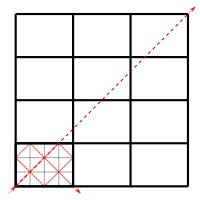
Seeing that the conjecture is true is a lot easier now. The bounces correspond to crossing lines – there are (k – 1) of them to cross in one direction and (n – 1) of them to cross in the other direction, so together that makes a total of (k – 1) + (n – 1) = k + n – 2 lines to cross. Seeing which corner it ends up in is a matter of keeping track of how things unfold. We’re all done now with quite an interesting journey.
Helping your child
Investigations are meant for your child to play with and think about. Let your child explore these looking for interesting patterns and beautiful relationships. Resist the temptation to unveil what is going on and give the answer. If your child seems to have reached a dead end, suggest that they come back to the investigation at a future time to play with it again.
Many investigations benefit from organizing results, and this is a great thing for you to help your child with. Help them make tables, drawings, or whatever may help them see more easily what is going on. And of course, it is perfectly fine to give them gentle nudges from time to time in the right direction. Remember that your child will learn a lot by developing persistence and learning how to look more deeply at things.