
Cover Factors and Multiplies
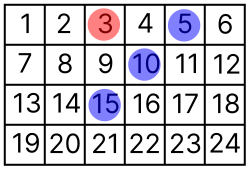
The setup
Have a board of numbers from 1 to 24. There are two kinds of tokens – a single token reserved for “the last move,” and a pile of other tokens.
How to play
The first player gets to pick any number and cover it with the last move token. After that, a player replaces the last move token with the other type of token and moves the last move token to any number that is a factor or multiple of the number from the last move.
How to win
The losing player is the one forced to cover the number 1.
Example
This board shows the middle of a game that started 10 -> 5 -> 15 -> 3.
Variations
As children get better at this game, they will discover rules they need to follow governing reasonable first moves. The most basic rule is that the first move cannot be on a prime number in the upper half of the numbers.
Adjust the range of numbers to the skill level of the players – 1 to 30, 1 to 48, or 1 to 60.
Helping your child
First and foremost, playing math games should be fun, like any other game your family plays together!
Please let your child make poor plays (mistakes) without correction, and resist the urge to tell them the best ways to play. Bit by bit, your child will get better at the game, and they will learn so much more if you let them figure things out. There is no hurry.
If you see your child make a mistake, ask them to describe why they decided to do what they did. If your child is stuck and doesn’t know which play to make, ask them to describe the pros and cons of their choices, or ask them about how they solved a similar situation in the past. If your child doesn’t remember how to do a calculation, discuss with them the methods they know for figuring it out. These conversations are important for helping your child to develop mathematically.
Through math game play and math conversations, you are helping your child learn to enjoy math and develop important problem solving skills!