Enclosed Sums
The setup
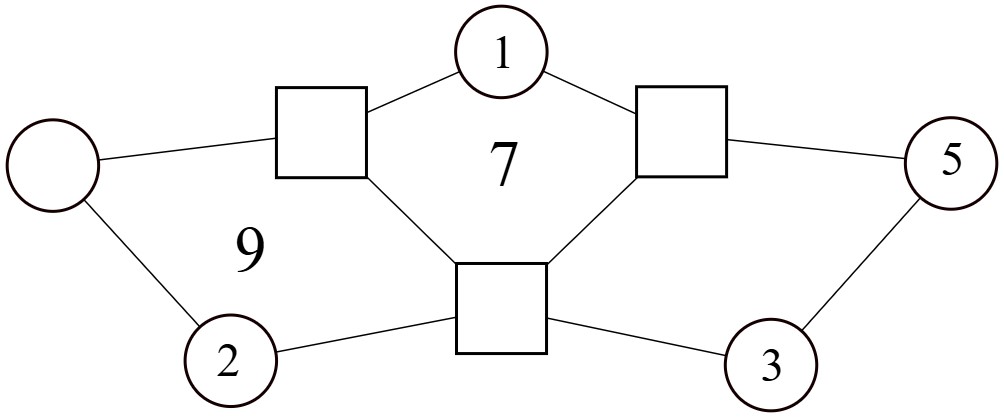
These puzzles have shapes connected by lines. Each enclosed region, such as where the 9 or the 7 are in this example, has a number that is the sum of the shapes that border it.
While circles may have any value, a non-circle must have the same value as any other figure of the same shape.
The challenge
Fill in the missing numbers in the shapes and the inside of the regions.
How to create
Create these puzzles by making a diagram of circles and maybe some squares. Next, fill in all the figures with numbers and fill in the bounded regions with the sum of the figures that surround them. Finally, remove some of the numbers.
Bonus Material
Puzzle
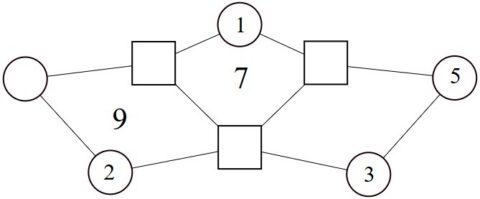
These puzzles have shapes connected by lines. Each enclosed region has a number that is the sum of the shapes that border it. Similar to Shape Sums puzzles, circles may have any value, and the value for a non-circular shape must be the same as any other shape of the same type. For example, all squares must have the same value and all hexagons would have the same value. You can optionally add the rule that different non-circular shapes must have different values – for example, that squares and hexagons must have different values.
The puzzle for your child is to figure out the numbers in the shapes and regions that are not supplied.
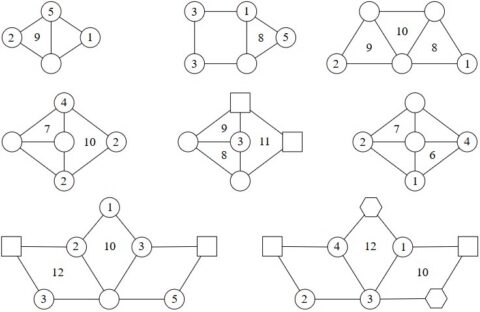
Create these puzzles by making a diagram of circles and maybe some other shapes. Next, fill in all the figures with numbers and fill in the bounded regions with the sum of the figures that surround them. Finally, remove some of the numbers.
As with Shape Sums puzzles in Chapter 3, start with simple puzzles with just one or two numbers missing and slowly progress to puzzles with more numbers missing, more enclosed regions next to each other, and more use of values in non-circular regions.
Helping your child
Puzzles are meant to be challenging and to take time, so please don’t ruin the fun by telling your child how to do them. These puzzles are chosen so that you can create them easily and then have fun solving them together.
If your child gets stuck on a puzzle, you have several options. You can, of course, give very small hints, if you can think of things that won’t give away the puzzle. You can suggest looking at smaller or simpler versions of the puzzle. Encourage your child to be bold in their ideas, even if sometimes they lead to dead ends. We all learn a lot from our mistakes and dead ends! Let your child know that it is perfectly okay not to solve a puzzle on the first (or second or third) try, and that useful ideas may occur to them if they leave the puzzle alone for a day or two.
These puzzles are meant to be fun and to teach problem solving. One of the greatest mathematical pleasures is that AHA moment, after many false starts and much wrestling with a problem, when the answer is finally discovered – be sure to let your child experience that feeling of discovery as many times as you can!