Island Hopping – Skip Counting
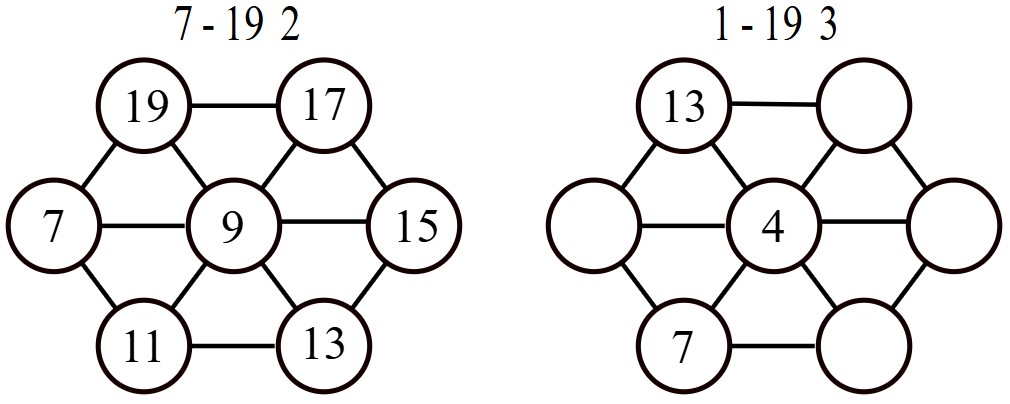
The islands (circles) are connected by bridges (lines), with connections made by skip counting. Some islands have numbers, and others start blank. Above the puzzle is the starting number, ending number, and skip amount.
The challenge
Fill in the missing numbers and find the path.
You can also place the numbers and blanks on the floor to make a stepping puzzle.
As with the Skip Counting activity, create puzzles to practice going forward or backward starting at a variety of numbers, not just numbers that are a multiple of the skip amount.
How to create
Create these puzzles by making the islands first, filling in the skip counting numbers, connecting those islands in the correct order, and then adding some additional connections to help make a puzzle out of it. In the version you give your child, remove some numbers leaving enough of the numbers so that it can still be figured out.
Bonus Material
These puzzles have islands (circles) connected by bridges (lines). In this version of Island Hopping, the connections are made by skip counting. Some of the islands have numbers written on them and some will start off blank. Above the puzzle is the starting number, ending number, and the skip amount. The challenge is to fill in the missing numbers and find the path. You can also place the numbers and blanks on pieces of paper on the floor to make a stepping puzzle.
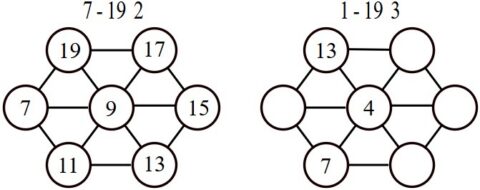
As with the Skip Counting activity, create puzzles to practice going forward or backward starting at a variety of numbers, not just numbers that are a multiple of the skip amount.
Creating these puzzles is the same as creating the Island Hopping – Counting puzzles from early in Chapter 2. Make the islands first, fill in the skip counting numbers, connect those islands in the correct order, and then add some additional connections to help make a puzzle out of it. In the version you give your child, remove some numbers leaving enough of the numbers so that it can still be figured out.
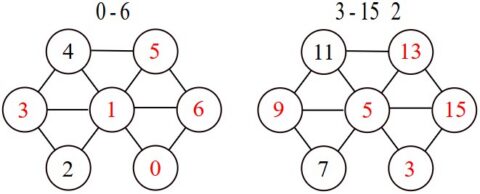
You can revisit the puzzle construction strategies described in the Bonus Material for Chapter 2 for Island Hopping – Counting. Also, if you still have any of those puzzles, it is very easy to convert one of those puzzles to one of these. Take the following puzzle from Chapter 2. It involves counting from 0 to 6. The red numbers are the ones that would normally be left out when the puzzle is given to your child. To convert it to a puzzle that starts at 3 and skip counts by 2, simply multiply all the numbers by 2 and then add 3 to them (leaving out the red ones, of course).
Helping your child
Puzzles are meant to be challenging and to take time, so please don’t ruin the fun by telling your child how to do them. These puzzles are chosen so that you can create them easily and then have fun solving them together.
If your child gets stuck on a puzzle, you have several options. You can, of course, give very small hints, if you can think of things that won’t give away the puzzle. You can suggest looking at smaller or simpler versions of the puzzle. Encourage your child to be bold in their ideas, even if sometimes they lead to dead ends. We all learn a lot from our mistakes and dead ends! Let your child know that it is perfectly okay not to solve a puzzle on the first (or second or third) try, and that useful ideas may occur to them if they leave the puzzle alone for a day or two.
These puzzles are meant to be fun and to teach problem solving. One of the greatest mathematical pleasures is that AHA moment, after many false starts and much wrestling with a problem, when the answer is finally discovered – be sure to let your child experience that feeling of discovery as many times as you can!