Sudoku Variations
The next two puzzles have the basic Sudoku rule that a square grid is filled with numbers so that each number appears exactly once in each row and column.
Make these puzzles by starting with a completely filled puzzle, removing many or all the numbers, and creating subregions and the appropriate extra information for that type of puzzle.
To save space, the examples here are all 4 by 4. You can make larger puzzles yourself, or you can find larger versions of these on the internet.
Bonus Material
Introduction
There are a great many Sudoku variations in the world, and there are even more other puzzles that are similar to those Sudoku variations. This section will look at five of these Sudoku variations. These all follow the rule of the “Latin Square” – that every number occurs exactly once in each row and column.
You can make any of these Sudokus by starting with a filled in puzzle of the appropriate type – either a Latin Square or a Jigsaw Sudoku. All of the Sudoku solutions given in the Bonus Material for Chapters 1-2 should be of use to you for this. After you have a solution in hand, add the additional information needed for this special kind of puzzle and remove some or all of the numbers.
Jigsaw Sudokus With Extra Information
These two puzzle types are Latin Squares that have the additional restriction that each subregion has every number occurring in it exactly once. In addition to being a Jigsaw Sudoku, they have additional properties.
Even-Odd Sudokus In these puzzles, the even numbers are greyed in. This additional information tends to make these puzzles very easy and it is usually possible to remove almost all the numbers.
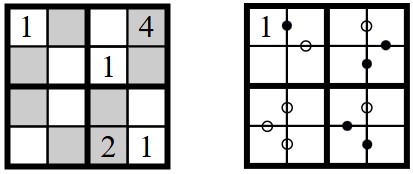
Kropki Sudokus This is the same as regular Sudoku except two types of dots placed between cells are added. If the dot is hollow, then the two numbers are one apart. If the dot is filled in, then one number is half the other number. Similar to Even-Odd puzzles, this additional information tends to make these puzzles pretty easy and that means that almost all numbers can be removed.
Sudokus With Adding and Subtracting
These puzzles are broken into subregions that have a target number assigned to them. Unlike standard Sudoku, it is allowed for a number to be repeated in a subregion as long as the puzzle is still a Latin Square. If a subregion has just one square in it, then the target number will be the value of that square.
In a Sumdoku Sudoku puzzle, the sum of all the numbers in a subregion is the given target number. In a Diffdoku Sudoku puzzle, all subregions have one or two squares. If a subregion has two squares, then the difference of the two numbers is the given target number.
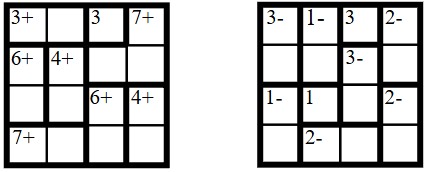
In a Sumdiffdoku Sudoku puzzle, both addition and subtraction are used. The subregions are marked with a “+” or a “-” to indicate whether to take a sum or difference.
The three types of puzzles are usually made with no numbers given in them. Of course, the subregions with one square are essentially squares with the number filled in. For a young child, you may want to supply quite a few of the numbers to make the puzzle within their sophistication level.
To vary the math calculations, use different groups of numbers instead of the usual 1 to 4 for a 4 by 4. For example, use the numbers 1, 3, 5, and 7. If you do this, list the numbers above the puzzle so your child will know what to use.