Turning the Tables
Math Concepts
multiplication and factors for numbers 1- 9
Materials
Puzzle, pencil
Players
1-4
Create
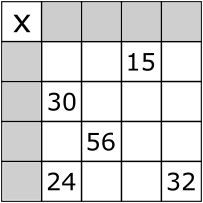
Filling in a standard multiplication table is boring, and children quickly realize they can fill it out using addition rather than multiplication. To really practice multiplication, as well as practicing problem solving and factoring, create a mixed-up multiplication table for your child.
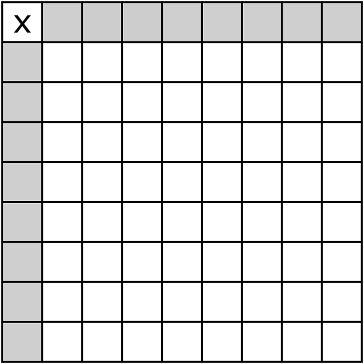
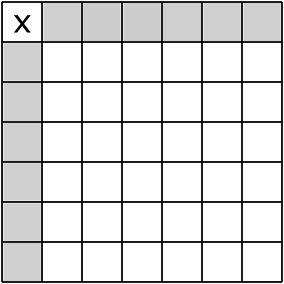
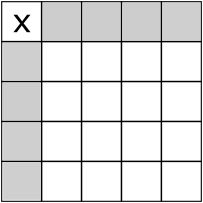
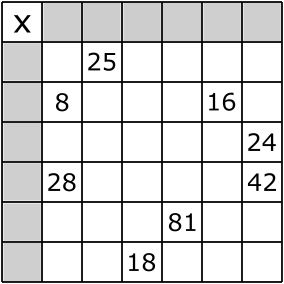
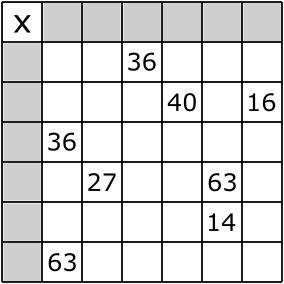
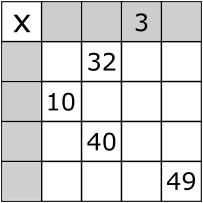
Start with a completely blank multiplication table that has 4 to 9 product rows and columns. Fill in as many of the entries as required to make the puzzle solvable and to set the right difficulty level. Don’t put the columns and rows in the standard order, and usually only use 2 through 9 for the rows and columns.
Challenge
The challenge is to fill in the missing numbers and complete the multiplication table.
Example:
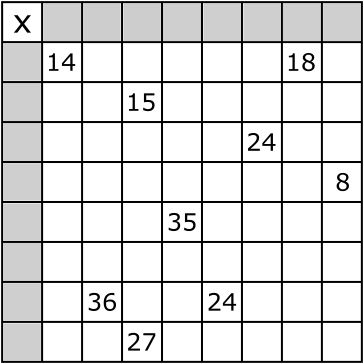
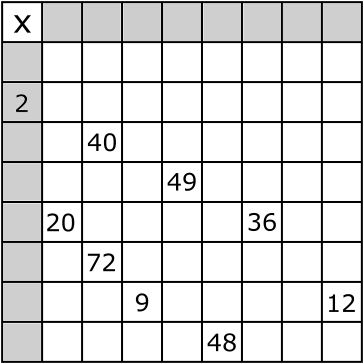
Here is an example puzzle using row and column headers of 2 to 9, together with a discussion of how to begin solving it.
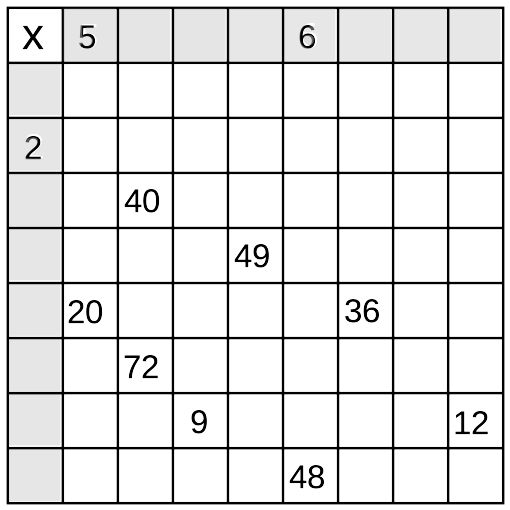
Solve this by starting with the entries that have easy factors to recognize. The 20 forces its row to be multiplying by 4, and then the 36 makes its column be 9. The 49 forces its column and row to be multiplying by 7. The 9 forces its column and row to be multiplying by 3. Now the 12 must be in the column for 4. Continue the detective work in this way and fill in the entries as the headings are discovered.
Notice that the column headers that have 5 and 6 in this puzzle were not needed. Both of those could have been omitted to add some more difficulty to this puzzle.
Variations
You can allow the possibility of duplicates of rows and columns to add a little more to figure out.
This has a lot of problem solving, so this lends itself to small group work.