
Broken Calculator – 2
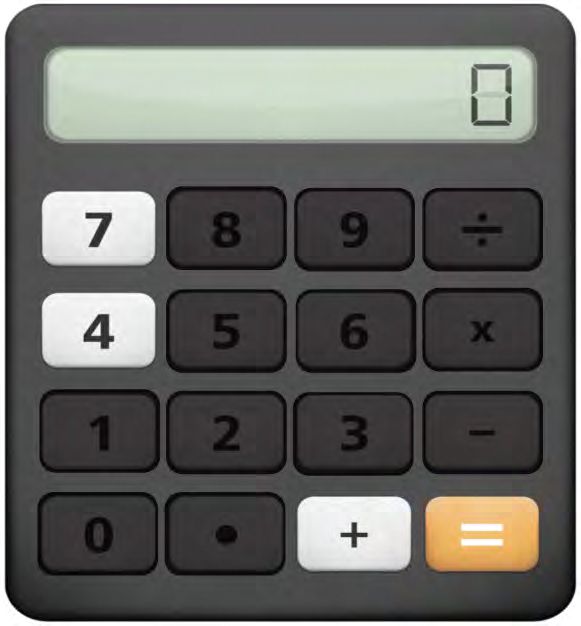
You have a calculator that is badly broken. Its only working keys are 4, 7, and +. With this limited ability, it is still possible to make certain numbers. For example:
15 = 7 + 4 + 4
25 = 7 + 7 + 7 + 4.
THE CHALLENGE
This calculator cannot make 1, 2, 3, 5, and 6. Find the largest number that cannot be made by this calculator.
EXPLORATION
Replace 4 and 7 by other pairs of numbers. Describe some patterns of what you see.
Notes
THE CHALLENGE & EXPLORATION
This is trickier than what happens in “Broken Calculator – 1.” The math theorem involved is affectionately called the McNugget Theorem. Suppose you have two relatively prime numbers n and m – that is, their greatest common factor (divisor) is 1. The theorem says that you can produce exactly half of the numbers from 1 to (n – 1) x (m – 1) as sums of positive multiples of n and m, and that starting with (n – 1) x (m – 1) you can produce every number thereafter.
Applying this theorem to 4 and 7, we know that we can produce half the numbers up to (4 – 1) x (7 – 1) = 18, and that from then on we can make all numbers. Let’s see how that works in this special case.
- 1 = Impossible
- 2 = impossible
- 3 = impossible
- 4 = 4
- 5 = impossible
- 6 = impossible
- 7 = 7
- 8 = 4 + 4
- 9 = impossible
- 10 = impossible
- 11 = 4 + 7
- 12 = 4 + 4 + 4
- 13 = impossible
- 14 = 7 + 7
- 15 = 4 + 4 + 7
- 16 = 4 + 4 + 4 + 4
- 17 = impossible
- 18 = 4 + 7 + 7
Without understanding any fancy number theory, the intrepid explorer might notice that half the numbers from 1 to 18 are possible and the other half are impossible. They might also notice the pattern that x is possible exactly when 17 – x is possible.
Another pattern to notice is that any common multiple of the two numbers will divide all of the sums of the multiples of the two numbers. This means that if the two numbers have a common multiple greater than 1, then there will be an infinite number of numbers that cannot be produced by that calculator. For example, combinations of 4 and 6 will never produce an odd number.