
Difference Squares
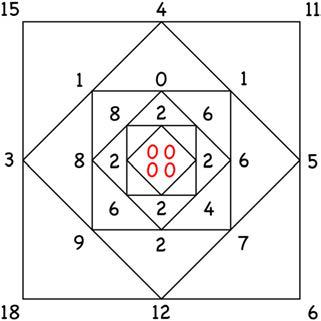
Start by putting numbers in the corners of a square. Then, put the differences of those numbers in the middle of the sides and make a new square with those differences. Continue this process and see where it takes you.
THE CHALLENGE
- This seems to end with four 0’s. If this is always true, can you explain why?
- The example went to four 0’s in the seventh round. Can you find examples that take much longer?
EXPLORATION
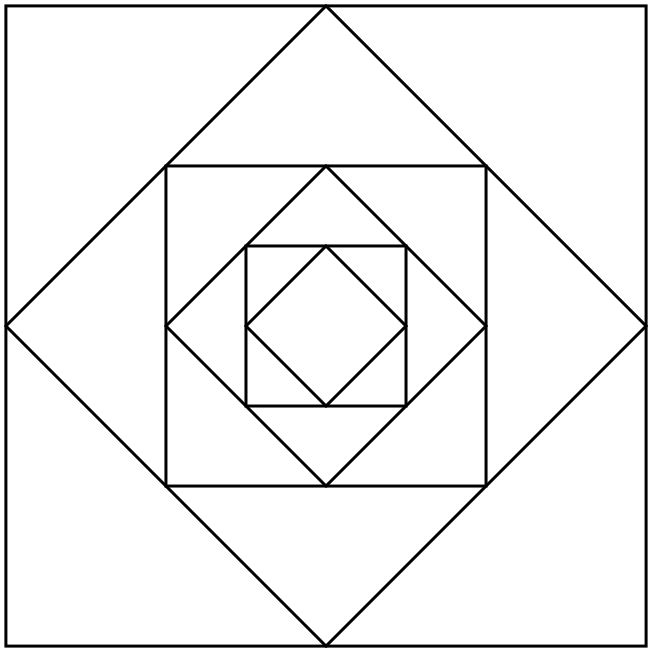
Investigate what happens if you use pentagons or hexagons instead.
Notes
THE CHALLENGE
First, just play with it and see what happens starting with various groups of starting numbers. Look for patterns and enjoy the experimentation. Here are some observations you can make.
Observation 1: If the four numbers are all positive, then the maximum number will decrease with each round.
Because the difference between two positive numbers is less than the larger of them, the maximum number must decrease.
Observation 2: If there are one or more 0’s, it may take more than one round, but after just a few rounds the maximum number will decrease (if it is not already 0).
This is just a matter of going through lots of cases of where the 0, or 0’s, is relative to where the maximum number(s) is. They all work out, but it is tiresome to read about.
Because the maximum number must continue to decrease, eventually all the numbers must be 0.
There is an alternative explanation that describes why all the numbers must end up being 0, but it uses more complex mathematics than you may want to read.
There is some sophisticated mathematics governing how to increase the number of rounds it takes to get to four 0’s. For now, simply let your students enjoy playing while trying to improve their best scores.
EXPLORATION
If you are interested in learning more about this, a good place to start is to look up “Ducci Sequence” in Wikipedia.