Equal Sums – 2
THE CHALLENGE
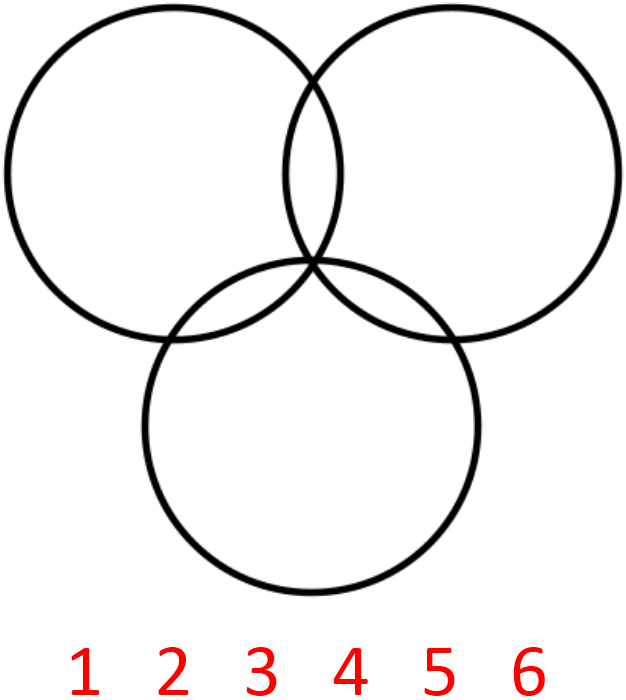
Here is a diagram created by overlapping three circles. The overlapping circles create six regions. Put a number in each of the six regions, using each of the numbers 1 to 6 exactly once, so that the sum of the numbers in each circle is the same.
EXPLORATION
How many different answers can you find? How do you know you have found them all?
Notes
THE CHALLENGE & EXPLORATION
Here are the four solutions. To see why these are the only ones, let A, B, and C be the three regions where two circles intersect, and let Sum be the common sum for the three circles. Calculate the total sum in two ways. As the sum of the three circles, the sum is 3 x Sum. As the sum of all six numbers plus A, B, and C the sum is 1 + 2 + 3 + 4 + 5 + 6 + A + B + C. The two things are equal, so that gives us 3 x Sum = 21 + A + B + C. Dividing by 3, we have Sum = 7 + (A + B + C)/3.
For Sum to be an integer in this last equation, A + B + C must be evenly divisible by 3. This allows for only four possibilities for A + B + C – it is either 6, 9, 12, or 15, and the corresponding values for Sum are 9, 10, 11, or 12.
The four solutions given here have Sum values of 9, 10, 11, and 12. As we shall see, these are all of the solutions!
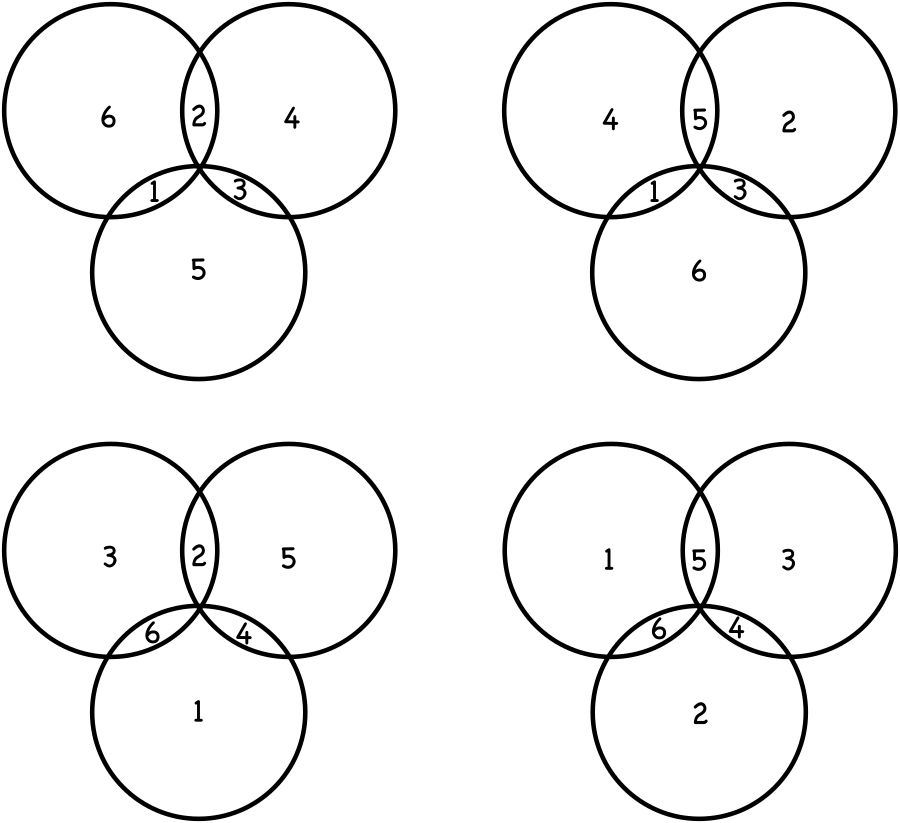
To save some work, note that if we take one solution and subtract all the entries from 7, we get another solution. Also, note that the new solution will have a Sum value which is 21 – (old Sum). Hence, the solutions for Sum values 9 and 10 give us the solutions for Sum values 11 and 12.
If A + B + C = 6, then A, B, and C are 1, 2, and 3, and Sum = 9. That is the upper left solution.
If A + B + C = 9, then Sum = 10 and (A, B, C) is (1, 2, 6), (1, 3, 5), or (2, 3, 4). If you check it, (1, 2, 6) and (2, 3, 4) are impossible. This leaves the upper right solution as the only Sum = 10 solution.
If you compare “Equal Sums – 2” with “Magic Triangles – 1,” you will see that they are the same puzzle!