
Filling Squares with Squares
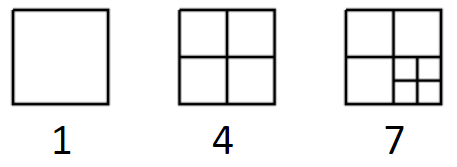
Here is how to fill one large square with 1, 4, or 7 squares.
THE CHALLENGE
Find other square counts for filling a large square. Can you do it for 2, 3, 5, 6, 8, 9, or 10 squares?
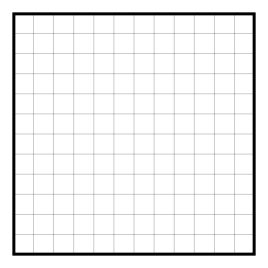
EXPLORATION
When possible, find more than one way to get some of these numbers.
Notes
THE CHALLENGE
Here is a systematic way of building up various counts.
Squares: A good place to start is with square numbers. It is easy to fill a square with 1, 4, and 9 squares by filling it, respectively, in a 1 by 1, 2 by 2, and 3 by 3 pattern.
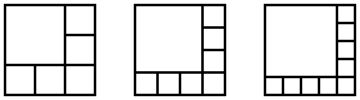
Even Numbers: After some experimentation, you can create patterns for 6, 8, 10, or any other larger even number as follows. Start with a large square and then put smaller squares around two sides of it as in these drawings.
Replacing One Square: The next big step is to see that any one square in a solution can be replaced by any other existing solution. For example, this was done in producing the pattern for 7 in the introduction – the square in the bottom right corner for “4” was replaced with four smaller squares to produce “7.”.
Whenever one square is replaced by four squares, that will increase the total square count by 3. Start with the list of solutions using square numbers and even numbers: 1, 4, 6, 8, 9, 10, 12, 14, and 16, and then add 3 to each entry on that list to get 4, 7, 9, 11, 12, 13, 15, and 17. Combining these two lists gives all the possibilities up through 17: 1, 4, 6, 7, 8, 9, 10, 11, 12, 13, 14, 15, 16, and 17. Using these ideas, every number above 17 is easy enough, and so we reach the conclusion that:
Answer: Every number is possible except 2, 3, and 5.
EXPLORATION
Some of these numbers can be produced in more than one way. For example, 9 can be done as a 3 by 3 pattern or as 6 plus three more.
There are many other patterns that can be created that are not made in the same way as these examples. For example, you can start with a 4 by 4 square and group 2 by 2 collections of squares into single 2 by 2 squares – each time you do that you will reduce the total count by 3.