
Fractions – 2
THE CHALLENGE: Use the numbers 1 to 9 at most once each to fill in the boxes. Make
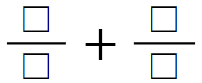
as small as possible. Also, use the numbers 1 to 9 at most once each to make
as large as possible.
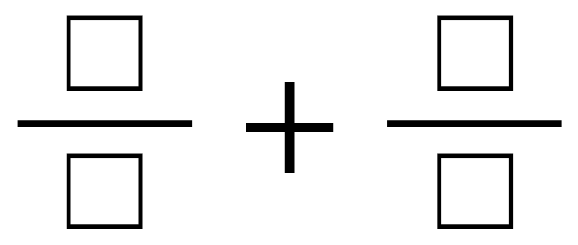

EXPLORATION
What happens if the fractions must be proper fractions?
Notes
THE CHALLENGE
To make the sum small, use large denominators to make each fraction small. The denominators should be 8 and 9, and the numerators will be 1 and 2.
Which numerator should go with which denominator? 1/8 + 2/9 or 2/8 + 1/9? This is easy to see if you think of this as 1/8 + 1/9 plus either 1/8 or 1/9. To increase it by as little as possible, choose 1/9.
So, to make it as small as possible, use 1/8 + 2/9.
To make it as large as possible, reverse the roles. Put 8 and 9 on top and 1 and 2 in the bottom. Once again, if you consider what will make the bigger increase to 8/1 + 8/2, you see it will be turning this into 9/1 + 8/2 = 13.
EXPLORATION
Insisting that the fractions are proper does not change the answer for the smallest value. To get the largest possible value with proper fractions, use large denominators and numerators that are slightly less than the denominator. That means considering 8/9, 7/8, 6/7, 7/9, and 6/8. After a small bit of playing around, 8/9 + 6/7 is the clear winner