
Ladybugs that don’t Add Up – 1
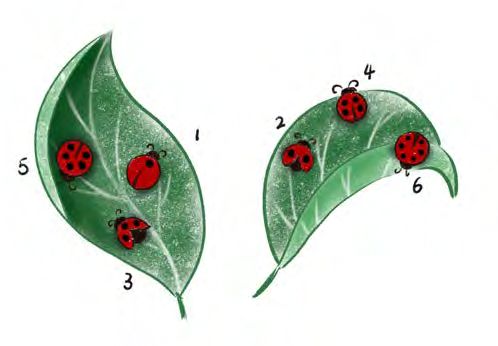
Numbered ladybugs are landing on two leaves. The rule is: the number of dots of two ladybugs on a leaf cannot add up to the number of dots on another ladybug on that leaf. The leaf on the left is fine, but the leaf on the right has 2 + 4 = 6.
THE CHALLENGE
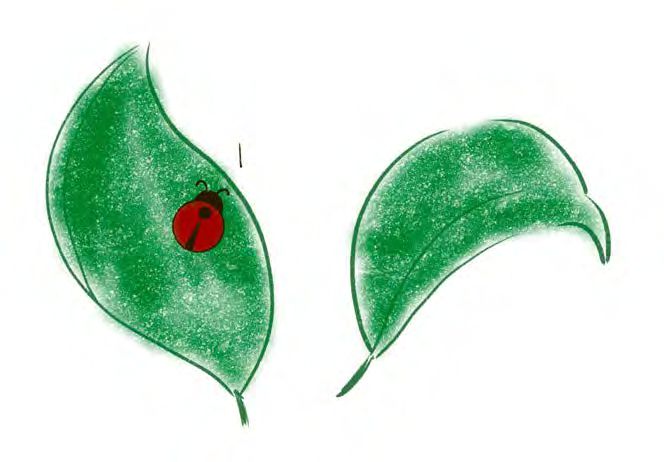
Starting at 1 and counting up, how high can you go putting the numbered ladybugs on two leaves while following the rule for both leaves?
EXPLORATION
How do things change if you use only even numbers? How do things change if you use only odd numbers? What are other groups of interesting numbers to look at?
Notes
THE CHALLENGE
This puzzle is all about experimenting, exploring, and keeping organized.
One general observation is that it is always safe to put all the numbers together between a number and twice that number. For example, one answer to this puzzle is (1 2) – (3 4 5 6). Powers of 2 are also safe to put together, for example (1 2 4 8) – (3 5 6 7) is an improvement.
To do this thoroughly and exhaustively requires being organized. There are five possibilities for how to place the numbers 1 to 4.
- (1 2 4) – (3): 5 and 6 have to go in the second group and then 8 in the first group. (1 2 4 8) – (3 5 6). 7 has to go in the second group, and then we are stuck. (1 2 4 8) – (3 5 6 7).
- (1 2) – (3 4): 7 must go in the first group (1 2 7) – (3 4). After that we must put 5 and 6 in the second group. (1 2 7) – (3 4 5 6). We are stuck.
- (1 3) – (2 4): 6 must go in the first group, and then 5 in the second. (1 3 6) – (2 4 5). We are stuck.
- (1 4) – (2 3): We are stuck – there is nowhere for 5.
- (1) – (2 3 4): 5 must go in the first group, and then we are stuck. (1 5) – (2 3 4). The winner is (1 2 4 8) – (3 5 6 7)!
EXPLORATION
Conveniently, working with even numbers on this problem is exactly the same as working with the original numbers, only everything is doubled. So, the best answer is: (2 4 8 16) – (6 10 12 14).
Strangely enough, working with odd numbers is even easier! We can put all the odd numbers on one leaf and have no problem! The sum of two odd numbers is always an even number.
Prime numbers are tempting, but they are almost as easy as the odd numbers.
Fibonacci numbers are interesting, but your students may not know about those. Look at 1, 2, 3, 5, 8, 13, 21, 34, and so on. Any two neighboring numbers add up to the next. However, they grow quickly enough that there are no further problems. So, you can alternate leaves and not have a problem: (1 3 8 21 …) – (2 5 13 34 …).