
Magic Flowers – 1
The sums in a Magic Flower are the same for all straight lines. These Magic Flowers use numbers from 1 to 5.
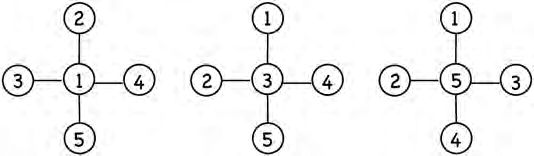
THE CHALLENGE
Use the numbers from 1 to 7 to make Magic Flowers.
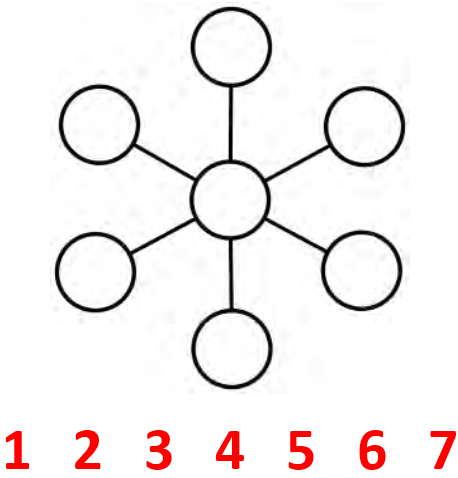
EXPLORATION
Play around with what happens with Magic Flowers with more than three lines.
Notes
THE CHALLENGE
Use this puzzle after the Magic Pluses puzzle.
This, like many of these Puzzles of the Week, can be attacked by playing around with the numbers until a solution is found. Don’t be tempted to think that a more structured approach is better for your students – a great deal will be learned about the mathematics involved and about problem solving by tenaciously working through many examples. Finding a solution, by any method, is always a wonderful reward.
Most of these “equal sum” puzzles can be attacked by adding up some of the straight lines. In the case of this puzzle, add up the three directions – this will include all the numbers once, plus the central circle’s number two extra times. The sum of 1 to 7 is 28. So, the sum of the three lines is 28 + 2×1, 28 + 2×2, 28 + 2×3, 28 + 2×4, 28 + 2×5, 28 + 2×6, or 28 + 2×7. Of those, only 30 = 28 + 2×1, 36 = 28 + 2×4, and 42 = 28 + 2×7 are divisible by 3. Dividing them by 3 tells us that the common sums are either 10 = 30 / 3, 12 = 30 / 3, or 14 = 30 / 3.
Let’s look at those three cases.
Common Sum of 10: The central circle will be 1. Making a sum of 10 with a 1 in the center means the other two numbers add up to 9. So, the three directions are: (2 1 7) – (3 1 6) – (4 1 5).
Common Sum of 12: The central circle will be 4. Making a sum of 12 with a 4 in the center means the other two numbers add up to 8. So, the three directions are: (1 4 7) – (2 4 6) – (3 4 5).
Common Sum of 14: The central circle will be 7. Making a sum of 14 with a 7 in the center means the other two numbers add up to 7. So, the three directions are (1 7 6) – (2 7 5) – (3 7 4).
EXPLORATION
Look at the Notes page for Magic Flowers – 2.