Magic Squares – 1
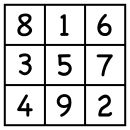
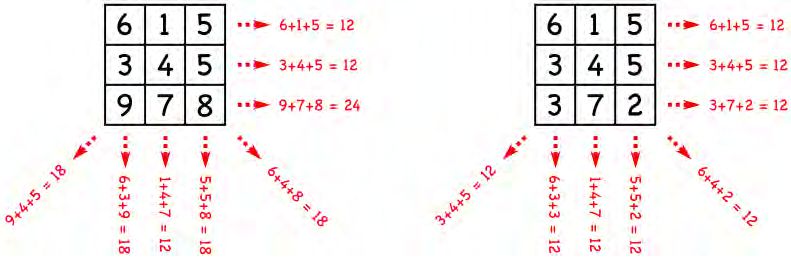
In a Magic Square, all the rows, columns and diagonals add up to the same number. This first square is not a Magic Square. The second one is a Magic Square with a constant sum of 12.
THE CHALLENGE
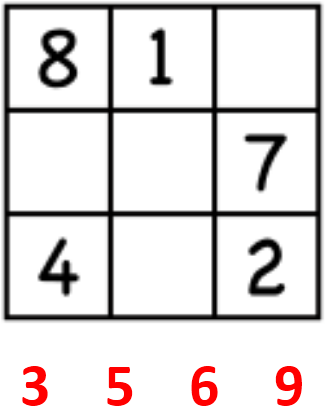
Use each of the numbers 3, 5, 6, and 9 once to complete this Magic Square
Notes
THE CHALLENGE
This is meant to be an introductory warmup puzzle for Magic Squares, so it doesn’t require much careful analysis. This, like many of these Puzzles of the Week, can be attacked by playing around with the numbers until a solution is found. Don’t be tempted to think that a more structured approach is better for your students – a great deal will be learned about the mathematics involved and about problem solving by tenaciously working through many examples. Finding a solution, by any method, is always a wonderful reward.
Looking at the upper right corner, we know that the common sum is equal to that corner plus 9 more (looking at its row and its column). Considering the diagonal the upper right corner is on, we know that the other two entries on that diagonal add up to 9. So the central square must be 5.
If the central square is 5, then we have a diagonal of (8 5 2), whose sum is 15. Now we’ve got the common sum.
In the bottom row, 15 = 4 + (middle square) + 2 tells us the middle square of the bottom row is 9. We can continue in this way now that we know the common sum.
The final solution (by rows) is: (8 1 6) (3 5 7) (4 9 2).