
Sujiko Puzzle – 3
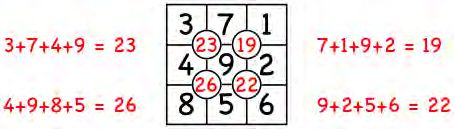
In a Sujiko puzzle, use each of the numbers from 1 to 9 once in the nine squares. The number in each circle must be the sum of the four squares that surround it.
THE CHALLENGE
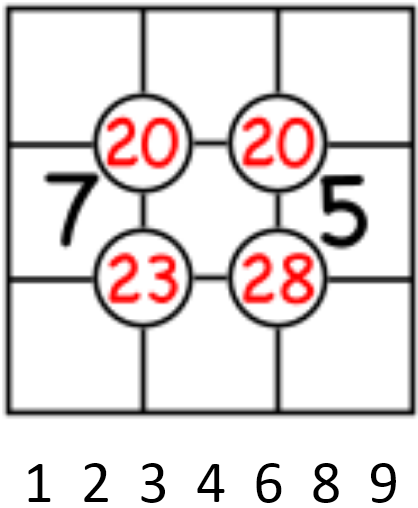
Fill in this Sujiko puzzle.
Notes
THE CHALLENGE
When solving a puzzle, look for its weak points, its easiest points of entry.
For this puzzle, the 28 in the circle is quite a big number and seems a good place to start. The three missing numbers in the bottom right 2 by 2 corner must add up to 28. The only way to get 28 from the list of numbers we have is to use 6, 8, and 9. So, we know those three numbers must be in that bottom right corner (and nowhere else).
Looking at the upper right 2 by 2 corner, 3 and 4 are the largest remaining numbers, so the central square must be 8 or 9. This means that the two numbers on the right side of the upper row are (3 4) when 8 is in the middle, or (2 4) when 9 is in the middle.
Suppose the central square is 8. This means the right side of the upper row is (3 4).
Looking at the bottom left 2 by 2 corner, the two squares shared with the bottom right 2 by 2 corner are (8 6) or (8 9). However, (8 9) makes it impossible to get a sum of 23 in the bottom left 2 by 2 corner. Therefore, it must be (8 6), and so the bottom left corner must be 2.
The only unused value is 1, which must go in the upper left corner. That makes the sum of the upper left corner either 1 + 3 + 7 + 8 = 19 or 1 + 4 + 7 + 8 = 20. The latter of the two is a solution!
Suppose the central square is 9. This means the right side of the upper row is (2 4).
Looking at the bottom left 2 by 2 corner, the two squares shared with the bottom right 2 by 2 corner are (9 6) or (9 8). However, (9 8) makes it impossible to get a sum of 23 in the bottom left 2 by 2 corner. Therefore, it must be (8 6), and so the bottom left corner must be 1.
The only unused value is 3, which must go in the upper left corner. That makes the sum of the upper left corner either 3 + 2 + 7 + 9 = 21 or 3 + 4 + 7 + 9 = 23, neither of which work!
Therefore, the only solution is given by (showing triplets as rows):
(1 4 3)
(7 8 5)
(2 6 9)