
Trapezoidal Numbers – 3
Trapezoidal Numbers are the sum of two or more consecutive numbers. They deserve their name because you can make a trapezoid with that many dots, as pictured in the examples below. Note that having 1 dot on the top row is stretching the idea of being a trapezoid a bit, but it is allowed for these numbers.
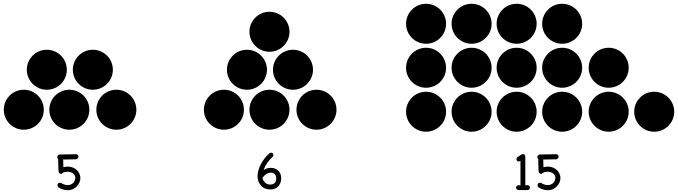
THE CHALLENGE
Which numbers can be expressed as the sum of 2 consecutive numbers?

EXPLORATION
Are there easy ways to describe numbers that can be expressed as the sum of 3 consecutive
numbers? 4 numbers? 5 numbers?
Notes
THE CHALLENGE & EXPLORATION
If a number is the sum of two consecutive numbers, then it is equal to n + (n + 1), which is 2n + 1. Numbers of the form 2n + 1 are the odd numbers starting with 3.
The sum of three consecutive numbers is (n – 1) + n + (n + 1) = 3n. Any multiple of 3 starting with 6 will be the sum of three consecutive numbers.
The sum of four consecutive numbers is (n – 1) + n + (n + 1) + (n + 2) = 4n + 2 = 2(2n + 1). Any number that is twice an odd number, starting with 10, will be the sum of four consecutive numbers.
The sum of five consecutive numbers is (n – 2) + (n – 1) + n + (n + 1) + (n + 2) = 5n. Any multiple of 5 starting with 15 will be the sum of five consecutive numbers.