
Trapezoidal Numbers – 2
Trapezoidal Numbers are the sum of two or more consecutive numbers. They deserve their name because you can make a trapezoid with that many dots, as pictured in the examples below. Note that having 1 dot on the top row is stretching the idea of being a trapezoid a bit, but it is allowed for these numbers.
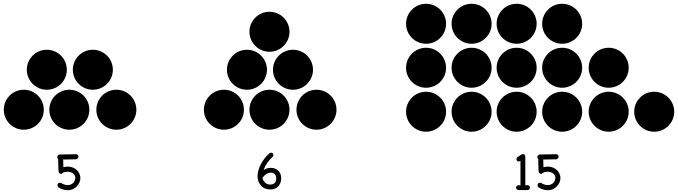
THE CHALLENGE
100 is a Square Number and a Trapezoidal Number. Find a group of consecutive numbers that add up to 100.

EXPLORATION
Can you find other ways of adding up consecutive numbers to get a sum of 100?
Notes
THE CHALLENGE & EXPLORATION
Because consecutive numbers form an arithmetic sequence, the formula for the sum of k consecutive numbers starting at n is k x (n + (n + k – 1)) / 2. You can think of this as k times the average value of all the numbers. You can also think of it as k times the median value of this arithmetic sequence of numbers.
If 100 = k x (n + (n + k – 1)) / 2, then 200 = k x (2n + k – 1). Each way of factoring 200 as a smaller number times a larger number gives us a possibility to consider:
- 1 x 200: k = 1, n = 100. We need at least 2 numbers, so k = 1 is impossible.
- 2 x 100: k = 2, n = 49 ½. n must be an integer, so this doesn’t work.
- 4 x 50: k = 4, n = 23 ½. n must be an integer, so this doesn’t work.
- 5 x 40: k = 5, n = 18. 100 = 18 + 19 + 20 + 21 + 22. Bingo!
- 8 x 25: k = 8, n = 9. 100 = 9 + 10 + 11 + 12 + 13 + 14 + 15 + 16. Bingo!
- 10 x 20: k = 10, n = 5 ½. n must be an integer, so this doesn’t work.
So, 100 = 18 + 19 + 20 + 21 + 22 = 9 + 10 + 11 + 12 + 13 + 14 + 15 + 16.