
Trapezoidal Numbers – 4
Trapezoidal Numbers are the sum of two or more consecutive numbers. They deserve their name because you can make a trapezoid with that many dots, as pictured in the examples below. Note that having 1 dot on the top row is stretching the idea of being a trapezoid a bit, but it is allowed for these numbers.
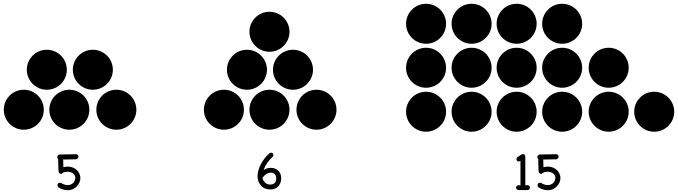
THE CHALLENGE
Which numbers can be expressed as a Trapezoidal Number in exactly one way?

EXPLORATION
Can you find a way to predict how many ways a number can be expressed as a Trapezoidal Number?
Notes
THE CHALLENGE & EXPLORATION
To get a feel for this, list out all the ways to write numbers as a sum of consecutive numbers. Writing out lots of examples is often a good way to look for patterns and get ideas.
- 1: No
- 2: No
- 3: 1 + 2
- 4: No
- 5: 2 + 3
- 6: 1 + 2 + 3
- 7: 3 + 4
- 8: No
- 9: 4 + 5; 2 + 3 + 4
- 10: 1 + 2 + 3 + 4
- 11: 5 + 6
- 12: 3 + 4 + 5
- 13: 6 + 7
- 14: 2 + 3 + 4 + 5
- 15: 7 + 8; 4 + 5 + 6; 1 + 2 + 3 + 4 + 5
- 16: No
- 17: 8 + 9
- 18: 5 + 6 + 7; 3 + 4 + 5 + 6
- 19: 9 + 10
- 20: 2 + 3 + 4 + 5 + 6
There is a pattern that is easy to see, and other patterns that are trickier.
1, 2, 4, 8, and 16 cannot be done. So it is reasonable to hypothesize that powers of 2 are not Trapezoidal Numbers.
9 has two ways, 15 has 3 ways, and 18 has two. For each of those, the number of ways is equal to the numberof odd numbers that evenly divide the number! All these ideas lead to the following conjecture:
Conjecture: The number of ways to write a number as a sum of consecutive numbers is equal to the number of odd divisors larger than 1 of the number.
This is enough for now. If any of your students saw these patterns, that is wonderful! We will explore this a bit further in the Notes to the next Puzzle of the Week.