Difference Pyramid
The challenge
The challenge is to put the numbers from 1 to 6 in a pyramid with one card in the top row, two cards in the second row and three cards in the third row, where each number is the difference of the two numbers directly below it.
Let your child take time and play with this. Most likely, just by playing around, they will happen upon a solution. However, if your child gets anxious, here are two tips that help. The 6 must be in the bottom row because it cannot be the difference of any pair of numbers. Similarly, the 5 must either be in the bottom row or in the middle row above the 6 and the 1.
Related challenges
If your child finds this easy to do, challenge them to find how many ways it can be done. Discuss what it means for two solutions to be different – if one solution is the mirror image of another, should it be considered different? Another challenge is to solve the harder puzzle of putting the numbers from 1 to 10 in a four-level difference pyramid.
Bonus Material
Introduction
The challenge is to place the numbers from 1 to 6 in a pyramid with one card in the top row, two cards in the second row and three cards in the third row, where each number is the difference of the two numbers below it.
If you are having trouble, here are two tips that help. The 6 must be in the bottom row because it cannot be the difference of any pair of numbers. Similarly, the 5 must either be in the bottom row or in the middle row above the 6 and the 1.
What are the “Different” Solutions?
If your child finds this puzzle easy to do, challenge them to find all the ways it can be done. Discuss what it means for two solutions to be different – if one solution is the mirror image of another, should it be considered different?
Answering the question of what makes solutions different is useful to do at the start. Because the mirror image of any solution is easy to make and is also a solution, it makes sense to ignore those. Ignoring mirror images will reduce the number of solutions to consider by half.
For example, we can assume that not only is the 6 in the bottom row, but it is either in the middle or the right side of the bottom row. Continuing that thinking with the 5, the bottom row can only have four possible layouts: 5 a 6, b 5 6, c 1 6, or d 6 1.
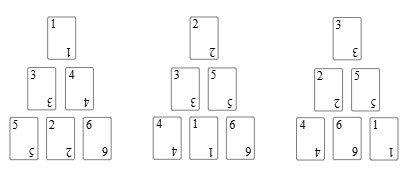
At this point it is a matter of working through the various possible values of a, b, c, and d. After some trial and error you will find that a is 2, b can never work, c must be 4, and d must be 4. So, ignoring mirror images, there are exactly three solutions:
Larger Pyramids
Let’s use the cards from 1 to 10 to make a pyramid with four rows. This is a lot more complicated. A few cards can be placed, but after that it requires some determination. Because 10 cannot be the difference of two cards, it must go on the bottom row. Similarly, either 9 is in the bottom row or it is in the next-to-the-bottom row above the 1 and the 10. The 8 and 7 cards are also good cards to use to get rid of possibilities.
This means the bottom row looks like one of the following (ignoring mirror images):
a b 9 10; c 9 d 10; 9 e f 10; g h 10 9; i 9 10 j; 9 k 10 L; m n 1 10; o 1 10 p; q r 10 1
That is a lot of possibilities to consider!
Fortunately, if you consider where 8 and 7 can go, the possibilities are reduced to the following list (assuming there are no mistakes!). It is easy to finish each one of these after you have the bottom row.
8 3 10 9; 6 1 10 8; 8 1 10 6
Pyramids of size 15, 21, or higher are left to the truly dedicated. Good luck and enjoy!
Helping your child
Puzzles are meant to be challenging and to take time, so please don’t ruin the fun by telling your child how to do them. These puzzles are chosen so that you can create them easily and then have fun solving them together.
If your child gets stuck on a puzzle, you have several options. You can, of course, give very small hints, if you can think of things that won’t give away the puzzle. You can suggest looking at smaller or simpler versions of the puzzle. Encourage your child to be bold in their ideas, even if sometimes they lead to dead ends. We all learn a lot from our mistakes and dead ends! Let your child know that it is perfectly okay not to solve a puzzle on the first (or second or third) try, and that useful ideas may occur to them if they leave the puzzle alone for a day or two.
These puzzles are meant to be fun and to teach problem solving. One of the greatest mathematical pleasures is that AHA moment, after many false starts and much wrestling with a problem, when the answer is finally discovered – be sure to let your child experience that feeling of discovery as many times as you can!