
Dominoes
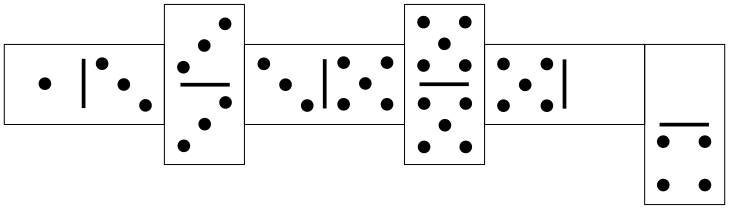
There are many variations to this ancient game – discuss the rules before you start!
The setup.
Mix up all tiles (bones) face down – this is called the boneyard. Take seven tiles each for two players, and five tiles each for three or four players. The player with the highest double starts by putting it on the table. If no one has a double, start the game over.
How to play.
A turn consists of placing a tile that matches one of the available ends of the string of dominoes (place double dominoes crosswise to the previous domino). If the player has no matching tile, the player is “blocked,” and there are two possible rules to use: 1) the player’s turn is over, or 2) the player keeps drawing tiles until there is a match (one version restricts this to a single draw whether or not there is a match). If the boneyard is emptied before there is a move, play passes to the next player on the right.
How to win
The game ends when a player runs out of bones, or when all players are blocked. The winner is the player with the lowest total of dots on their tiles (which is 0 if they have used up all their tiles).
Variations
Scoring options: The winner’s score can be calculated in two ways. The traditional way is to use the sum of the dots on all the other players’ tiles. Rounds are played until a player reaches 50 or 100. For little ones, a better scoring system is to let the winner have the score which is the count of all the other players’ tiles.
Matching options: When your child starts adding, change the rule for matching – two tiles match if their numbers add up to six (or nine if using a larger range of dominoes).
Helping your child
First and foremost, playing math games should be fun, like any other game your family plays together!
Please let your child make poor plays (mistakes) without correction, and resist the urge to tell them the best ways to play. Bit by bit, your child will get better at the game, and they will learn so much more if you let them figure things out. There is no hurry.
If you see your child make a mistake, ask them to describe why they decided to do what they did. If your child is stuck and doesn’t know which play to make, ask them to describe the pros and cons of their choices, or ask them about how they solved a similar situation in the past. If your child doesn’t remember how to do a calculation, discuss with them the methods they know for figuring it out. These conversations are important for helping your child to develop mathematically.
Through math game play and math conversations, you are helping your child learn to enjoy math and develop important problem solving skills!