Factor Trees
The model for factor trees is an extension of Shape Products from the previous Feel the Power page. The goal in creating a factor tree is to reduce a number to its prime factors. Many things can be learned about a number in the process of constructing a factor tree.
Example
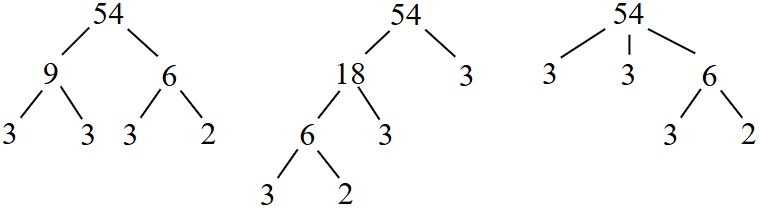
Start with a number, say 54. This can be broken down several ways. One way is 9 × 6, another is 18 × 3, and yet another is 3 × 3 × 6. Each produces a start to a factor tree.
Each of these trees ultimately produces the same primes on its leaves. In each case we end up with 2 × 3 × 3 × 3, but look at the different ways of getting there!
Questions
After doing some examples like these, your child may naturally start asking some questions.
- Why do some trees have more levels than others?
- Why are some trees broader than others?
- Why do the leaves always stop at primes?
- Why do the leaves always have the same list of primes, perhaps with rearrangement?
Helping your child
Investigations are meant for your child to play with and think about. Let your child explore these looking for interesting patterns and beautiful relationships. Resist the temptation to unveil what is going on and give the answer. If your child seems to have reached a dead end, suggest that they come back to the investigation at a future time to play with it again.
Many investigations benefit from organizing results, and this is a great thing for you to help your child with. Help them make tables, drawings, or whatever may help them see more easily what is going on. And of course, it is perfectly fine to give them gentle nudges from time to time in the right direction. Remember that your child will learn a lot by developing persistence and learning how to look more deeply at things.