Island Hopping – Compensation
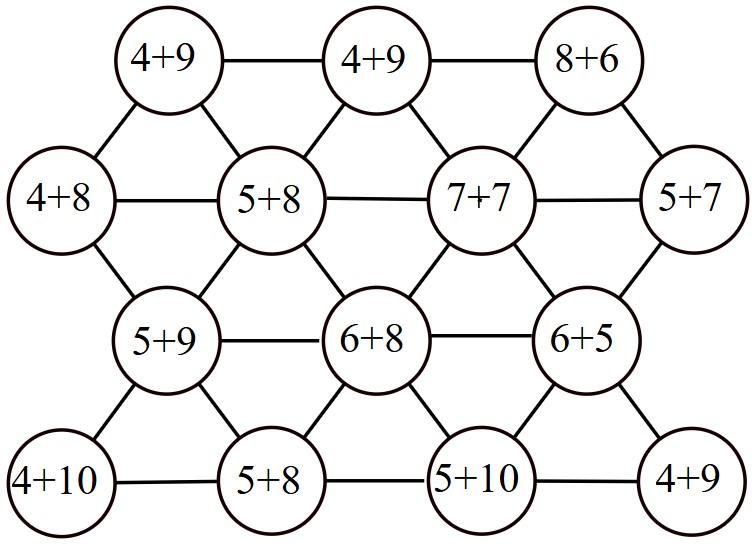
These puzzles show how using compensation creates easier addition problems.
The challenge
Find a path that connects all the islands that have the same answer. Two islands can only connect if their problem’s numbers differ by 1 – with one number increased by one and the other decreased by one.
For example, ‘5 + 8’ would connect with ‘6 + 7.’ Only some of the islands will be on the path. In this example, the path starts in the lower left and ends in the upper right.
How to create
Make these puzzles by starting with about ten empty circles with some connections. Identify a path from one edge of the islands to the other. Along that path, put in problems whose numbers differ from each other by one. In the nearby islands, put problems with small changes that have different answers.
Bonus Material
Puzzle
Using compensation for addition is a way to make addition problems much easier. The idea is to take an amount away from one of the numbers being added and give it to the other other number – the result stays the same, but one of the numbers becomes easier to work with.
For example, when you add 7 + 8, if you take 2 away from 7 and give it to the 8, the problem becomes 5 + 10. Alternatively, if you take 3 away from the 8 and give it to the 7, the problem becomes 10 + 5. Anytime you can make one of the numbers a multiple of 10, you will have a much simpler problem.
These puzzles provide practice in creating new problems using compensation. The challenge is to find a path that connects all the islands with the same answer. It is only legal to connect two islands if their problem’s numbers differ by 1. Only some of the islands will be on the path.
Make these puzzles by starting with about ten islands with some connections. Identify a path from one edge of the islands to the other. Along that path, put problems that differ from each other by one – perhaps start with a problem that involves adding 10, and then make variations on it. In the islands near to the path, put problems with small changes that have different answers.
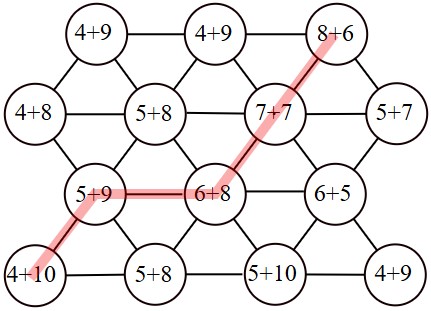
There really is little to be done to vary the hardness of these puzzles. Introducing false paths will probably lead to confusion rather than challenge, and so it is generally a bad idea.
Helping your child
Puzzles are meant to be challenging and to take time, so please don’t ruin the fun by telling your child how to do them. These puzzles are chosen so that you can create them easily and then have fun solving them together.
If your child gets stuck on a puzzle, you have several options. You can, of course, give very small hints, if you can think of things that won’t give away the puzzle. You can suggest looking at smaller or simpler versions of the puzzle. Encourage your child to be bold in their ideas, even if sometimes they lead to dead ends. We all learn a lot from our mistakes and dead ends! Let your child know that it is perfectly okay not to solve a puzzle on the first (or second or third) try, and that useful ideas may occur to them if they leave the puzzle alone for a day or two.
These puzzles are meant to be fun and to teach problem solving. One of the greatest mathematical pleasures is that AHA moment, after many false starts and much wrestling with a problem, when the answer is finally discovered – be sure to let your child experience that feeling of discovery as many times as you can!