Shape Sudoku
The setup
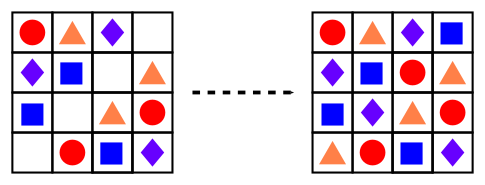
Use four tokens each of four different types. For example, use different colored gummy bears. We have used orange triangles, blue squares, red circles, and purple diamonds.
How to create
Create one of these puzzles by starting with the answer – this will be a pattern of tokens with one of each kind in each row and column, and one of each kind in each 2 by 2 corner box of the grid. Once you have the “answer,” pull off some of the tokens and place them in a pile to the side.
The challenge
Give the puzzle to your child to figure out how to put back the tokens that were pulled off.
Puzzle creation strategies
Here are some simple strategies for creating puzzles: remove one token from each row; remove all of one kind of token and one each of the other tokens; or remove one entire row and column.
Bonus Material
Introduction
This is your child’s first math puzzle, and that’s pretty cool! It also means you should take it very slowly so your child has lots of success and fun, and very little frustration.
The rules for these 4 by 4 Sudokus are very simple. There are four different types of tokens. There should be one of each kind of token in each row, column, and 2 by 2 corner of the puzzle. Use moveable pieces so that it is easy for your child to experiment in finding solutions.
The first puzzles you make should just have one token missing from each row. Once your child understands and figures out those puzzles, you can move to trickier ones, but do not be in a hurry.
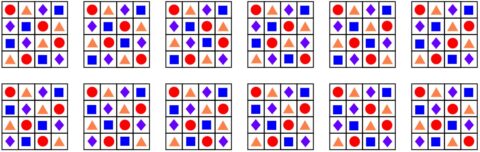
The easiest way to create these puzzles is to start with a finished Sudoku and remove some of the tokens. To help you to do that, there are a number of finished Sudokus supplied below. After those finished examples, there is a list of methods you can use to create puzzles from a finished puzzle.
Finished Sudokus
Before giving you a collection of finished Sudokus, there is one thing to note. You can take any one of these and create 23 more of them simply by interchanging token types – for example, you can take a finished puzzle and create a “new” one by swapping the circles and triangles and swapping the diamonds and squares.
The examples below are distinctly different from each other and cannot be made from each other by doing interchanges. You can create more examples from these by doing such interchanges if you like.
Methods for Creating Sudokus From Solved Ones
Once you have a finished Sudoku, you can use any of the following strategies to create a puzzle that has a unique solution. Generally speaking, the more tokens you remove, the harder the puzzle will be.
- Remove a single token from each row or from each column.
- Remove a single token from each 2 by 2 corner.
- Remove all of one kind of token from the entire puzzle.
- Remove all tokens from one 2 by 2 corner.
- Remove one entire row and one entire column.
- Remove all of one kind of token and one each of the other kinds of tokens.
- Remove all tokens from two 2 by 2 opposite corners.
- Remove all tokens from two 2 by 2 opposite corners and 1 token each from the other two corners.
Of course, these are not the only methods you can use. They are just supplied here as sure-fire general methods that will quickly create puzzles.
Helping your child
Puzzles are meant to be challenging and to take time, so please don’t ruin the fun by telling your child how to do them. These puzzles are chosen so that you can create them easily and then have fun solving them together.
If your child gets stuck on a puzzle, you have several options. You can, of course, give very small hints, if you can think of things that won’t give away the puzzle. You can suggest looking at smaller or simpler versions of the puzzle. Encourage your child to be bold in their ideas, even if sometimes they lead to dead ends. We all learn a lot from our mistakes and dead ends! Let your child know that it is perfectly okay not to solve a puzzle on the first (or second or third) try, and that useful ideas may occur to them if they leave the puzzle alone for a day or two.
These puzzles are meant to be fun and to teach problem solving. One of the greatest mathematical pleasures is that AHA moment, after many false starts and much wrestling with a problem, when the answer is finally discovered – be sure to let your child experience that feeling of discovery as many times as you can!