Shape Sums
The challenge
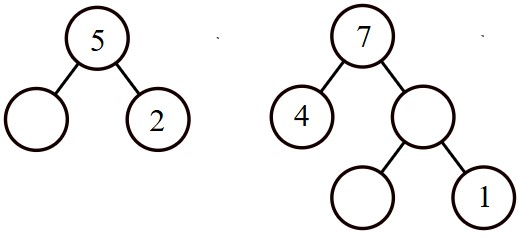
Fill in the missing circles so that every circle is the sum of all the circles directly below and connected to it.
The easiest puzzles have most of the circles filled in. For older children, there are variations that involve larger numbers and cleverer solutions.
Repeated numbers
One option is to use non-circular shapes for repeated numbers. While the value in a circle may duplicate the value in some other circle or shape, the value in a non-circular shape must match the value in all other places with the same shape.
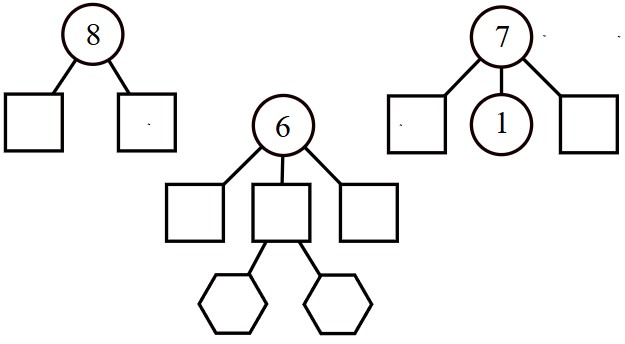
For example, all squares have the same value in a given puzzle. Use matching shapes to practice adding twins, near twins, and halving – in the first example, the solver is asked to find a number that is half of 8.
How to create
Make these puzzles by starting with a diagram that is completely filled in and then removing some numbers. If the puzzle has some repeated numbers, use a square, triangle, or other shape instead of a circle for that repeated number.
Bonus Material
Introduction
These puzzles use numbered circles connected in an upward fashion, and every circle is the sum of all the circles directly below and connected to it.
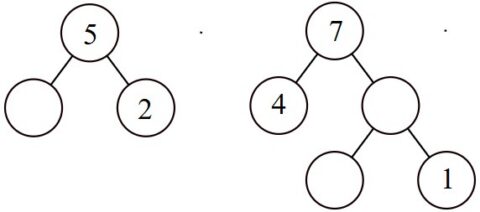
The easiest puzzles have most of the circles filled in. Here are two examples that are straightforward to solve.
These puzzles can be made more difficult by having one circle used in more than one direction. All of the next seven puzzles are direct calculations except the rightmost one of the first row. It is trickier because the one circle in the middle is shared by two unknown circles above it. That puzzle involves small enough numbers that it can be solved easily with a little trial and error.
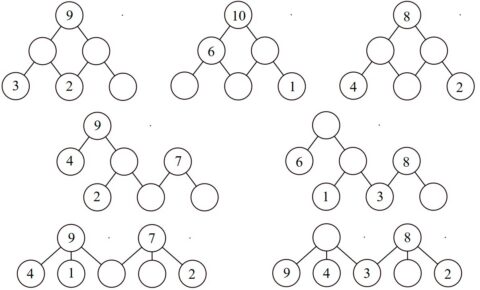
Another option for adding complexity to these puzzles is to use non-circular shapes. While the value in a circle may or may not duplicate the value in some other circle or shape, the value in a non-circular shape must match the value in all other places with the same shape. For example, all squares have the same value. Use matching shapes to practice adding twins, near twins, and halving.
If you like, you can add the rule that two non-circular shapes that have different shapes must have different values – for example, a square and a hexagon would have to have different values.
Make any of these puzzles by starting with a diagram that is completely filled in and then removing some numbers. If the puzzle has some repeated numbers, use a square or other shape instead of a circle for that repeated number.
The next two puzzles illustrate the psychological difference between using a circle from two directions and replacing the circle with two squares. These two puzzles are essentially the same, but a young child will find the first one much easier to understand and work with. Please give your child plenty of practice with circle-only puzzles before venturing into more sophisticated puzzles with non-circular shapes.
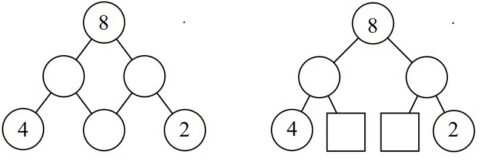
Puzzles similar to the next three are useful for practicing adding twins, near twins, and triples.
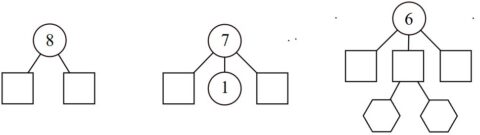
Here are some examples of using non-circular shapes to make trickier puzzles. If your child enjoys these, there are a great many more variations to explore. Happy puzzling!
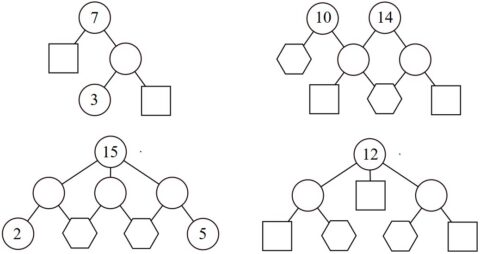
Helping your child
Puzzles are meant to be challenging and to take time, so please don’t ruin the fun by telling your child how to do them. These puzzles are chosen so that you can create them easily and then have fun solving them together.
If your child gets stuck on a puzzle, you have several options. You can, of course, give very small hints, if you can think of things that won’t give away the puzzle. You can suggest looking at smaller or simpler versions of the puzzle. Encourage your child to be bold in their ideas, even if sometimes they lead to dead ends. We all learn a lot from our mistakes and dead ends! Let your child know that it is perfectly okay not to solve a puzzle on the first (or second or third) try, and that useful ideas may occur to them if they leave the puzzle alone for a day or two.
These puzzles are meant to be fun and to teach problem solving. One of the greatest mathematical pleasures is that AHA moment, after many false starts and much wrestling with a problem, when the answer is finally discovered – be sure to let your child experience that feeling of discovery as many times as you can!