
The Product Game
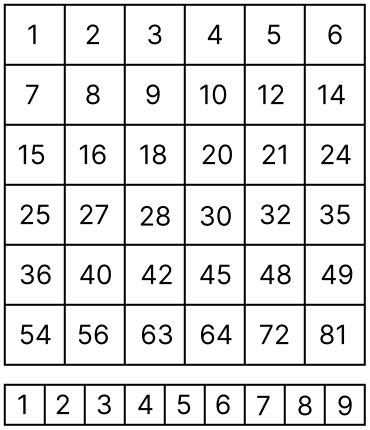
The setup
Use a shared piece of paper filled out as shown.
How to play
The first player moves a token onto any number from 1 to 9 in the 1-9 squares. The second player puts another token on one of the 1-9 squares and claims the product in the 6 by 6 grid. From then on, each player chooses to move either of the two tokens and claims the product (if they can).
How to win
The first player with 3 squares in a row wins.
Variations
Mix up the product numbers to give your child better practice identifying the products. Also, see the Stage 5 Bonus Material for designs of larger boards with larger ranges.
Bonus Material
Introduction
Use a shared piece of paper filled out as follows:
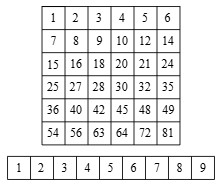
The first player moves a token onto any number from 1 to 9 in the 1-9 squares on the bottom row. The second player puts another token on one of the 1-9 squares on the bottom row and claims the product in the 6 by 6 grid. From then on, each player chooses to move one of the two tokens and claim the product (if they can). The first player to claim 3 squares in a row wins. Mix up the product numbers in the 6 by 6 grid to give your child better practice identifying the products.
Bigger Boards
These playing boards can be made as large as you like, though they do get to be quite large pretty quickly. Here are a few larger boards with the corresponding larger number ranges beneath them.
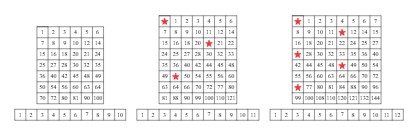
The squares with red stars are “free” squares and may be used by either side as needed.
Helping your child
First and foremost, playing math games should be fun, like any other game your family plays together!
Please let your child make poor plays (mistakes) without correction, and resist the urge to tell them the best ways to play. Bit by bit, your child will get better at the game, and they will learn so much more if you let them figure things out. There is no hurry.
If you see your child make a mistake, ask them to describe why they decided to do what they did. If your child is stuck and doesn’t know which play to make, ask them to describe the pros and cons of their choices, or ask them about how they solved a similar situation in the past. If your child doesn’t remember how to do a calculation, discuss with them the methods they know for figuring it out. These conversations are important for helping your child to develop mathematically.
Through math game play and math conversations, you are helping your child learn to enjoy math and develop important problem solving skills!