Nim – Diagonal
Math Concepts
Counting 1- 9
Materials
Game board, 1 token
Players
2
Set up
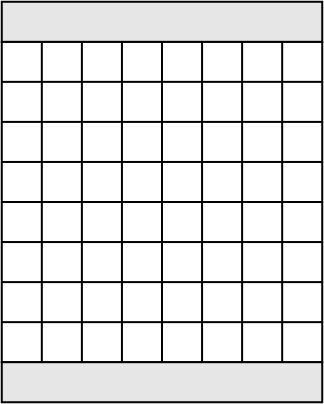
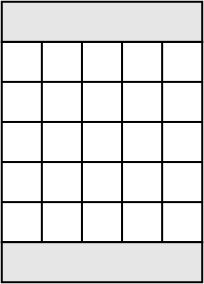
As with Nim – 1, 2, there are many variations for this game (as described under Variations). However, the variations are fairly small. Start with a game board and a shared token. Put the token in the upper gray band. The players decide who will move first.
Play
The first play is a move into any of the squares in the topmost row of squares. After that, the players alternate turns, moving the token either one square down, one square to the right, or diagonally one square to the right and down.
Goal
The player who moves the token into the bottom gray band wins.
Discussion and Tips
As with most of the other versions of Nim, this is an ideal activity for practicing the problem solving technique of “Learn from simpler versions of a problem.” Lead a discussion where you keep track of who wins if you start in various squares. Label the squares with a W or an L depending on whether, if it is your move, you are guaranteed to win or lose. Start this analysis with the bottom row of squares and work your way up. For example, the bottom row of squares would all have a W. The row above the bottom row would be marked with L W L W L, and the row above that would be marked W,W,W,W,W. What is the pattern that emerges over all the rows? Why does that pattern occur?
Variations
Change the board size: This can be played with any board size. Use smaller boards for younger players, or for when you want the games to go more quickly.
Winning versus Losing: For most versions of Nim, you can choose to make the person who lands in the final square the loser instead of the winner.
Start at A and end at Z: Ignore the upper and lower gray bands, and have the token start at the upper leftmost square. The winner (or loser if you like) is the player who ends up at the lower rightmost square.
Change the token moves: Play that the token can move right or down, but not diagonally. Or, play that the token can move right or diagonally, but not down. Or, perhaps allow it to move one or two spaces at a time.