Revealing Products
Math Concepts
Multiplication / factors numbers 1 to 9
Materials
Paper slips with numbers on them
Players
1- 2
Create
Start with a blank multiplication table that has 4 product rows and 4 product columns. There are also groups of four missing numbers at the top and left sides– these will have some of the numbers from 2 to 9. Fill in the table out of sight, and then flip over or cover all the numbers. Use pieces of paper with numbers written on them.
Challenge
Your student can ask to reveal, one at a time, up to 10 of the 16 product entries. The goal is to figure out the entries for the top and left sides before running out of turns.
Example
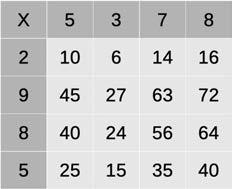
Imagine that all the cards were flipped over in this example. If your child chose to flip over the card that happened to have the 63 under it, they would know it came from a 7 and a 9. Flipping over any other card in the same row or column as the 63 would indicate where the 7 and 9 are. Suppose the second card they flipped over was where the 56 is. Not only would they know that the third column was for 7, they would also know that the second row was for 9 and the third row was for 8.
Discussion and Tips
Talk about which entries help the most. In general, entries that involve the fewest prime factors will be the most informative to see. For example, numbers such as 25 and 49, which are squares of primes, help a lot. Numbers that are the product of two primes, such as 14 and 35, also determine a lot of information.
Variations
Larger sizes of puzzles also work. For example, a table with 5 blank rows and columns that allows for the student to use up to 12 flips will work well. Pick numbers for the top and left sides that you want your students to practice with.
You can choose to allow the possibility that some of the rows or columns are duplicates if you like.