
Coin Flipping – 3
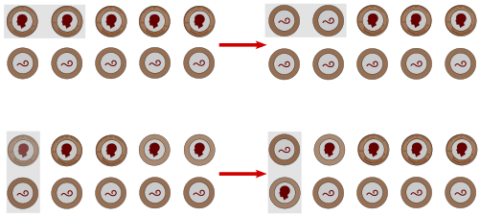
Ten coins are set up as shown on the left side. The first five coins are heads and the second five are tails. During one move, you are allowed to flip over any two coins.
THE CHALLENGE
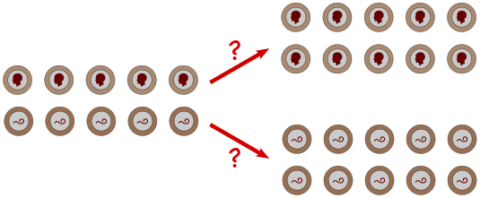
Take the original configuration of coins and, through a series of double-flip moves, make all ten coins heads or all ten tails. Show how this can be done or describe why it is impossible.
Notes
THE CHALLENGE
Consider the number of heads before any move involving two flips. There are three possibilities when flipping two coins.
- The two coins were both heads up to start. After the flips, these coins will be heads down, and the number of heads up coins will be reduced by two.
- The two coins were both heads down to start. After the flips, these coins will be heads up, and the number of heads up coins will be increased by two.
- One coin was heads up and the other was heads down. After the flips, the coins will be heads down and heads up, so there will be no change in the number of heads up coins.
Consequently, the number of heads up coins will either increase by two, stay the same, or decrease by two. The number of heads up coins starts at five, and will always change by an even amount, so it must remain an odd number no matter what we do. Therefore, this number can never become ten or zero, and so it is impossible to have all the coins end up in the same orientation.