
Fill in the Blanks – 6
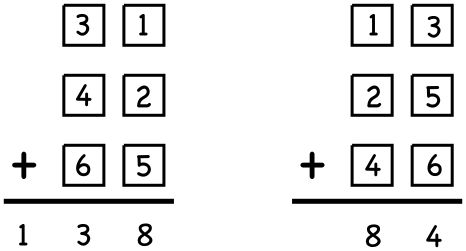
These sums, using the numbers from 1 to 6 once each, are not particularly close to 100.
THE CHALLENGE
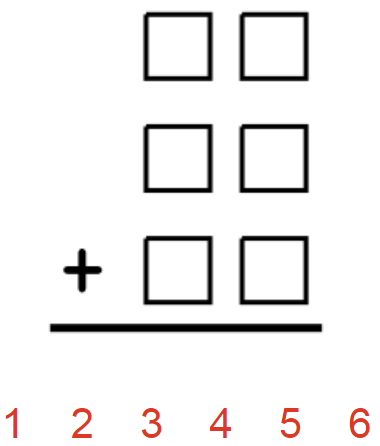
Use the numbers from 1 to 6 once each to make a sum as close to 100 as possible.
EXPLORATION
How does your answer change if you use the numbers from 1 to 7 or 1 to 8 instead, using each number no more than once.
Notes
THE CHALLENGE
A useful thing to notice is that it does not matter how we pair up the numbers in the ones column with the numbers in the tens column, so that is one less thing to think about.
To get close to 100, we want the tens column to add up to 8, 9, or 10. Because the sum of the numbers from 1 to 6 is 21, we can subtract the sum of the tens column from 21 to see what the sum of the ones column will be. In all there can be only three possible sums to consider:
- The tens column sums to 8 and the ones column sums to 13, which gives an overall sum of 93.
- The tens column sums to 9 and the ones column sums to 12, which gives an overall sum of 102.
- The tens column sums to 10 and the ones column sums to 11, which gives an overall sum of 111.
Of these 102 is the best. Any combination of digits in the tens column that sums to 9 will give the best possible answer. The things that work are 1 + 2 + 6, 1 + 3 + 5, and 2 + 3 + 4.
Here are some typical answers all of which sum to 102: 13 + 24 + 65, 16 + 34 + 52, and 21 + 35 + 46.
EXPLORATION
The analysis for the numbers from 1 to 7 is nearly the same as before. We still want the tens column to add up to 8, 9, or 10. The sum of the remaining digits will have some variability thanks to the wider range.
- The tens column sums to 8. The largest that 3 of the remaining 4 numbers can sum to is 17 (4 + 6 + 7), with overall sum 97.
- The tens column sums to 9. The smallest that 3 of the remaining 4 numbers can sum to is 12, with overall sum 102. The same answer as using the numbers from 1 to 6. The 7 is of no use here.
- The tens column sums to 10. We don’t need to look at this as it will be too large.
To look at 1 to 8, we only need to look at the tens column adding up to 8 or 9. As before, if the tens column sums to 9, the best we can do will be 102. The question is, can we do better when the tens column sum is 8? If we use 1 + 3 + 4 in the tens column, then we can use 5 + 7 + 8 = 20 in the ones column. We can hit 100 exactly!
So, one best answer for 1 to 8 is 15 + 37 + 48 = 100. There are plenty more that you can create by moving around the ones column numbers.