
Equal Sums – 4
THE CHALLENGE
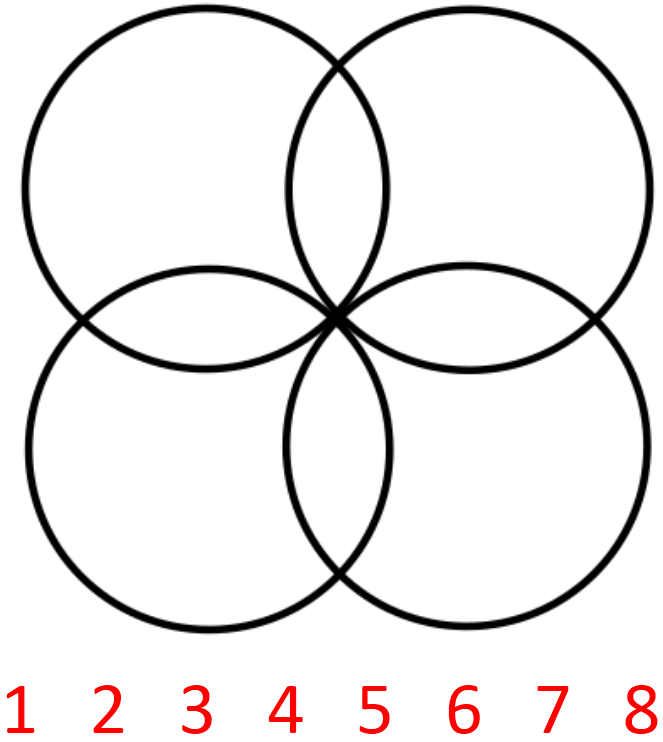
Here is a diagram created by overlapping four circles. The overlapping circles create eight regions. Put a number in each of the eight regions, using each of the numbers 1 to 8 exactly once, so that the sum of the numbers in each circle is the same.
EXPLORATION
How many different answers can you find? Do you think there are any more? What happens if you use other number ranges? Are there other interesting problems like this with intersecting circles?
Notes
THE CHALLENGE & EXPLORATION
Start by deciding which sums are possible for the common sum for all circles. Let Sum be that value. Let A, B, C, and D be the values of the four regions where two circles intersect. The sum of the four circles is 4 x Sum, and it is also 1 + 2 + 3 + 4 + 5 + 6 + 7 + 8 + A + B + C + D. Then we have the equation 4 x Sum = 36 + A + B + C + D, so Sum = 9 + (A + B + C + D) / 4. The smallest that A + B + C + D can have is 1 + 2 + 3 + 4 = 10. This needs to be divisible, so it’s smallest possible value is 12, which means the smallest possible value is Sum = 9 + 12/4 = 12.
Note that any solution can be turned into another solution by subtracting all entries from 9. Doing this will turn the old Sum into 27 – Sum. Consequently, the only possible values for Sum are 12, 13, 14, and 15. Because 12 and 15 are tied together, and 13 and 14 are tied together, we only need to check for solutions for 12 and 13.
Here are solutions for Sum with values 12 and 13. It turns out these are the only ones for these two sums.
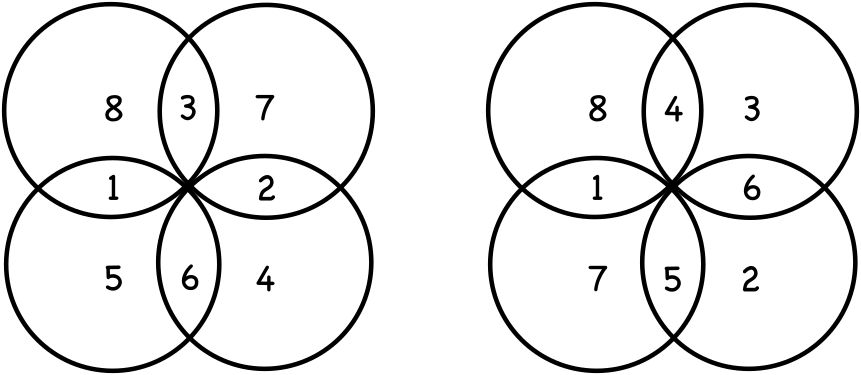
Notice that the numbers in the center of circles not touching each other add up to the same thing. For example, in the leftmost diagram, 8 + 4 = 5 + 7. Prove that this always happens with a bit of algebra. Let K and L be the values in the centers of two of the opposite circles, and let M and N be the other two values. If we add up the regions for the two circles for K and L we get 2 x Sum = K + L + (A + B + C + D). Similarly, adding up the regions for the two circles for M and N gives 2 x Sum = M + N + (A + B + C + D). This forces K + L = M + N.
Also, note that since 4 x Sum = 36 + A + B + C + D, we get 2 x Sum = M + N + (4 x Sum – 36). Rewriting this we have M + N = 36 – 2 x Sum. For our four values of Sum, 12 through 15, the values of M + N are 12, 10, 8, and 6.
Because 12 = 4 + 8 = 5 + 7 are the only ways to get 12, the solution above for Sum = 12 is the only solution. While 10 = 2 + 8 = 3 + 7 = 4 + 6 suggests there are more possibilities for Sum = 13, a quick check of the three possible pairings of (2, 8), (3, 7), and (4, 6) shows that the solution above is the only one for Sum = 13.