
Fill in the Blanks – 2
Using the numbers from 1 to 5 at most once, this equation has three solutions.
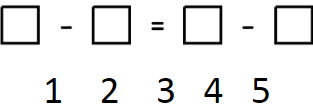
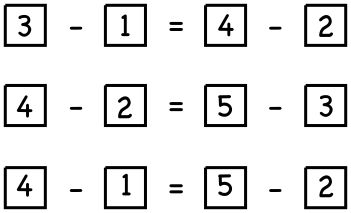
The three solutions are:
THE CHALLENGE
Use the numbers from 1 to 8 at most once to fill in these blanks.

EXPLORATION
Explore other number ranges. What happens if you use 1 to 7, 1 to 9, or 1 to 10? How do things change if you use 0 to 7?
Notes
THE CHALLENGE
As with the other Fill in the Blanks puzzles, a child can just play with this and eventually arrive at the answers. That exploration involves a lot of good experiences, and there is no reason to avoid it.
To be more systematic, the key observation is that the subtraction drives the solution.
For a difference of 5, the sums must be 1 + 4 and 2 + 3, and that uses up all the numbers from 1 to 4.
For a difference of 6, if the subtraction is 7 – 1 or 8 – 2, there aren’t two ways of getting a sum of 6 without using a 1 (if it’s 7 – 1) or a 2 (if it’s 8 – 2).
So, the difference must be 7, and the last subtraction must be 8 – 1. Without using a 1, the sum of 7 can be achieved as 2 + 5 or 3 + 4, and that’s our single solution.
EXPLORATION
We saw above that 1 to 7 cannot work.
Using the range 1 to 9 opens up more possibilities involving the 9.
- 9 – 1 = 8 gives 2 + 6 = 3 + 5 = 8.
- 9 – 2 = 7 gives 1 + 6 = 2 + 5 = 7
- 9 – 3 = 6 gives 1 + 5 = 2 + 4 = 6
Using the range 1 to 10 now allows us to use the 10.
- 10 – 1 = 9 gives 2 + 7 = 3 + 6 = 4 + 5 = 9
- 10 – 2 = 8 gives 1 + 7 = 3 + 5 = 8
- 10 – 3 = 7 gives 1 + 6 = 2 + 5 = 7
- 10 – 4 = 6 gives 1 + 5 = 2 + 4 = 6
- 10 – 5 = 5 gives 1 + 4 = 2 + 3 = 5
Putting 0 in the range produces quite a few surprises. There are solutions for the ranges as small as 0 to 5!
- 1 + 4 = 2 + 3 = 5 – 0
- 1 + 5 = 2 + 4 = 6 – 0
- 0 + 5 = 2 + 3 = 6 – 1
- 0 + 4 = 1 + 3 = 6 – 2
- 1 + 6 = 2 + 5 = 3 + 4 = 7 – 0
- 0 + 6 = 2 + 4 = 7 – 1
- 0 + 5 = 1 + 4 = 7 – 2
- 0 + 3 = 1 + 2 = 7 – 4