
Filling Squares w/ Different Boxes
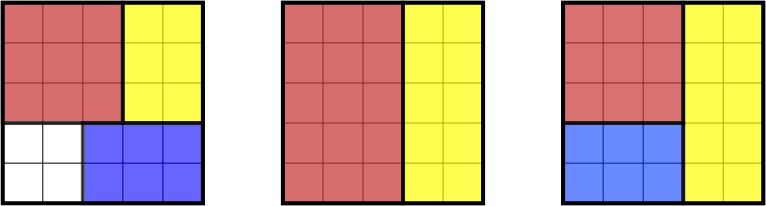
This is the Mondrian Arts Puzzle created by Gordon Hamilton. The goal is to fill a square with all different rectangles that are roughly the same size. Use the score, which is the difference of the areas of the largest and smallest rectangles, to measure how successful the diagram is. The scores of these three squares, from left to right, are 9 – 4 = 5, 15 – 10 = 5, and 10 – 6 = 4. However, the leftmost square is not allowed as it has two rectangles with the same dimensions (2 by 3 and 3 by 2).
THE CHALLENGE
Find designs with the lowest scores you can for legally breaking up a 3 by 3, 4 by 4, 5 by 5, and 6 by 6 square.
Notes
THE CHALLENGE & EXPLORATION
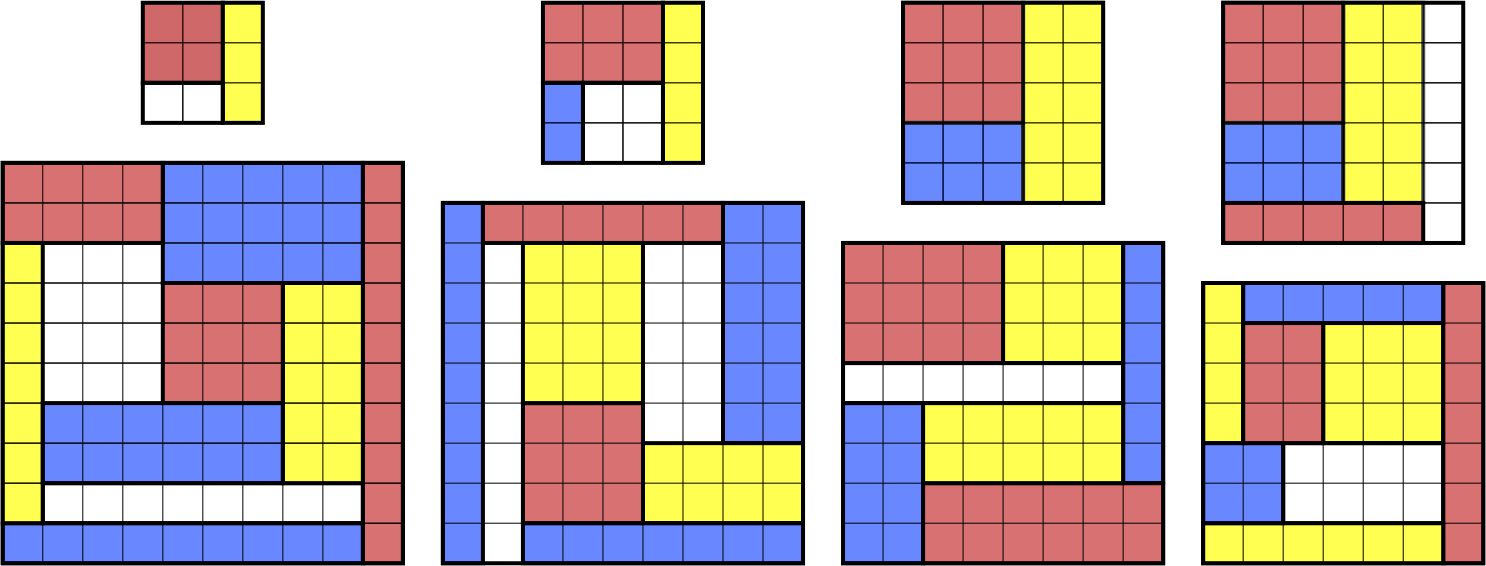
Here are some solutions for 3 by 3 through 10 by 10. There are of course other solutions, not shown, for most of these sizes.
The difference in areas is:
- 3: 4 – 2 = 2
- 4: 6 – 2 = 4
- 5: 10 – 6 = 4
- 6: 10 – 5 = 5
- 7: 9 – 4 = 5
- 8: 12 – 6 = 6
- 9: 12 – 6 = 6
- 10: 15 – 7 = 8
There are some general principles that can help get you started. When looking at a square with odd dimensions, such as 7 by 7, it can always be broken up nearly in half as a 4 by 7 and a 3 by 7 – this has a score of 7. In general, this method provides a score of n for an n by n square with n odd. This is not usually the best possible score, as is seen by the 5 by 5 example on the main page, yet it is a good place to start.
Another relatively easy thing to try is to put a narrow strip (one or two wide) on the right and bottom edges together with a previous solution. This type of construction was used for the 3 by 3, 5 by 5, 6 by 6, 7 by 7, and 10 by 10.