
Finding Squares – 3
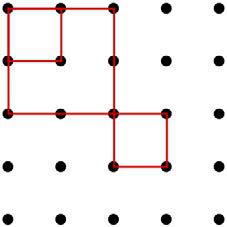
Drawn in red in this grid are two 1 by 1 squares and one 2 by 2 square with horizontal and vertical sides.
THE CHALLENGE
Find all the different sizes of squares you can in this grid. Note that there are some squares that do not have horizontal and vertical sides. For each size square you find, what is its area? Once you know its area, what is its side length?

EXPLORATION
Can you discover different methods for finding these areas? Can you find a formula for the side length using just the description of one side?
Notes
THE CHALLENGE & EXPLORATION
Finding the area of the squares with horizontal and vertical sides is easy enough. There are four of these of sizes 1 by 1, 2 by 2, 3 by 3, and 4 by 4, with areas 1, 4, 9, and 16.
The other squares are a bit trickier. The insight is to cut the region into pieces whose area we know. Alternatively, we can surround the square by a bigger square and look at the pieces inside it.
Let’s look at a square formed by a side that goes over three and up one.
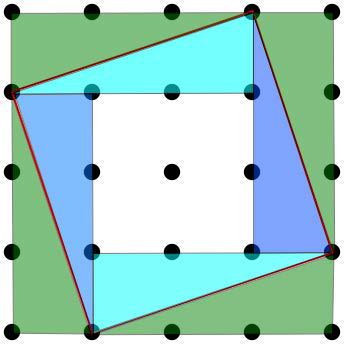
We can find the area by putting together the four interior blue right triangles together with the white square. That produces an area of 4 x (½ x 3 x 1) + 2 x 2 = 6 + 4 = 10. The side length will be the square root of 10. We can also find the area by taking the big outer square and subtracting off the four green right triangles. That produces an area of 4 x 4 – (4 x (½ x 3 x 1)) = 16 – 6 = 10, just as before.
A similar process can be used for any of the diagonal squares.
After doing several of these, the interested student may notice a pattern in this. Your students’ algebra may not be up to this, but a pattern with the numbers, if laid out in a table, can still be seen in lieu of using letters. Let “a” is the amount the side goes to the right, and “b” is the amount the side goes up. Finding the area from the inside amounts to adding 4 x (½ x a x b) + (a – b) x (a – b), which is 𝑎2 + 𝑏2. Finding the area from the outside yields (a + b) x (a + b) – 4 x (½ x a x b), which simplifies to the same result.
What we have done is found two proofs for the Pythagorean Theorem!