
Fractions – 10
THE CHALLENGE
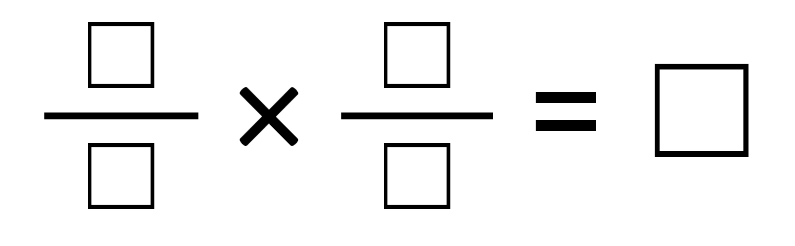
Use the numbers 2 to 9 at most once each to fill in these boxes. There are a lot of answers that are essentially the same, so organize them with increasing numerators and denominators.

Notes
THE CHALLENGE & EXPLORATION:
Write the equation with variables to make it easier to talk about: A/B × C/D = E. Multiplying both sides by B and D turns this into A × C = B × D × E. As there is only one 5 and one 7, they cannot be put into this equation. Thinking in terms of primes helps a lot. We need to balance the number of 2’s and 3’s on both sides of this equation using the remaining six numbers: 2, 3, 4, 6, 8, and 9.
The 3’s are more limited, so there are only three possibilities.
- There are no multiples of 3. This only leaves three numbers, which is not enough.
- 3 is on one side and 6 is on the other side. We will need to use all three of the remaining numbers. Unfortunately, none of these cases leads to a solution.
- 9 is on one side and 3 and 6 are on the other side.
- 9 on the left: 9 x 4 = 3 x 6 x 2; 9 x 8 = 3 x 6 x 4
- 9 on the right: does not work
So, there are two possible ways for A x C = B x D x E. In each of these ways, if you isolate one of the numbers on the right side and make it E, you can divide by the other two numbers on the right side and get a solution to the original problem. You can pair up the answers by putting the numerators and denominators in increasing order..
- 2: (4 x 9) / (3 x 6)
- 3: (4 x 9) / (3 x 6); (8 x 9) / (4 x 6)
- 4: (8 x 9) / (3 x 6)
- 6: (4 x 9) / (2 x 3); (8 x 9) / (3 x 4)