
Fractions – 12
THE CHALLENGE
Use the numbers 1 to 9 at most once each in each set of boxes.
First, make
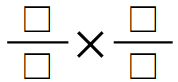
equal to 2/3, and then find values that make
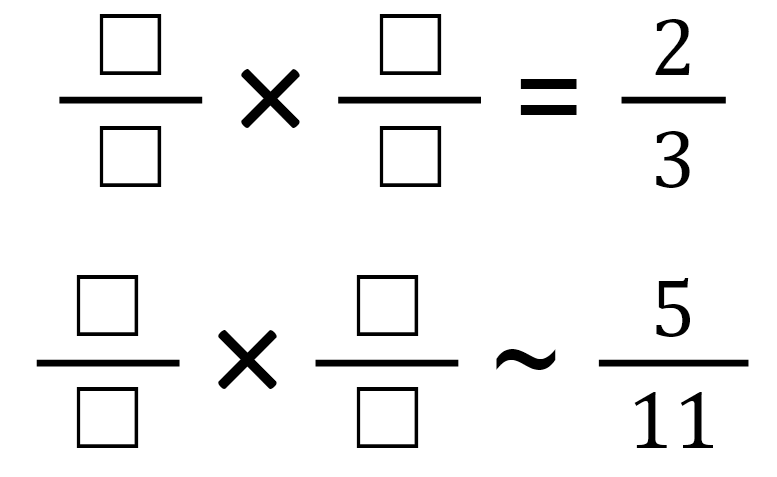
as close as possible to 5/11.

Notes
THE CHALLENGE
I will write the expression as A/B x C/D to make it easier to talk about.
Part 1: A/B x C/D = 2/3. Multiply both sides by 3 x B x D, so this becomes 3 x A x C = 2 x B x D. Look at this using the prime factors 2 and 3 – these must balance on the two sides of the equation. From 3, 6, 9, we have four factors of 3 to work with. From 2, 4, 6, 8 we have seven factors of 2 to work with. There are two cases for handling the 3’s.
- Case 1: Neither A nor C is 3 or 6, and B is 3 or 6.
- B=3: 3 x A x C = 2 x 3 x D reduces to A x C = 2 x D. Solutions to this are 1 x 4 = 2 x 2, 1 x 8 = 2 x 4.
- B=6: 3 x A x C = 2 x 6 x D reduces to A x C = 4 x D. The solution to this is 1 x 8 = 4 x 2.
- Case 2: A is 3 or 6, and B is 9.
- A=3: 3 x 3 x C = 2 x 9 x D reduces to C = 2 x D – the options for (C, D) are (2, 1), (4, 2), and (8, 4).
- A=6: 3 x 6 x C = 2 x 9 x D reduces to C = D, which is impossible.
So, the solutions to the problem are given by:
- (1 x 4) / (3 x 2)
- (1 x 8) / (3 x 4)
- (1 x 8) / (6 x 2)
- (3 x 2) / (9 x 1)
- (3 x 4) / (9 x 2)
- (3 x 8) / (9 x 4)
Part 2: A/B x C/D ~ 5/11. Multiply both sides by 11 x B x D to turn this into 11 x A x C ~ 5 x B x D. We want to find multiples of 11 that are close to multiples of 5 and that can be produced using 1 to 9.
Here is the list to consider. These are multiples that are 1 apart and are producible using 1 to 9: 11 x 4 ~ 8 x 5; 11 x 9 ~ 20 x 5; and 11 x 16 ~ 35 x 5. The bigger the numbers are, the better, so let’s look at this last one.
(2 x 8) / (5 x 7) = 16 / 35 is very close to 5/11 – they differ by 1 / (35 x 11) = 1 / 385.
Perhaps the multiples that are two or three apart will work out better? There do not seem to be any candidates that would be an improvement.